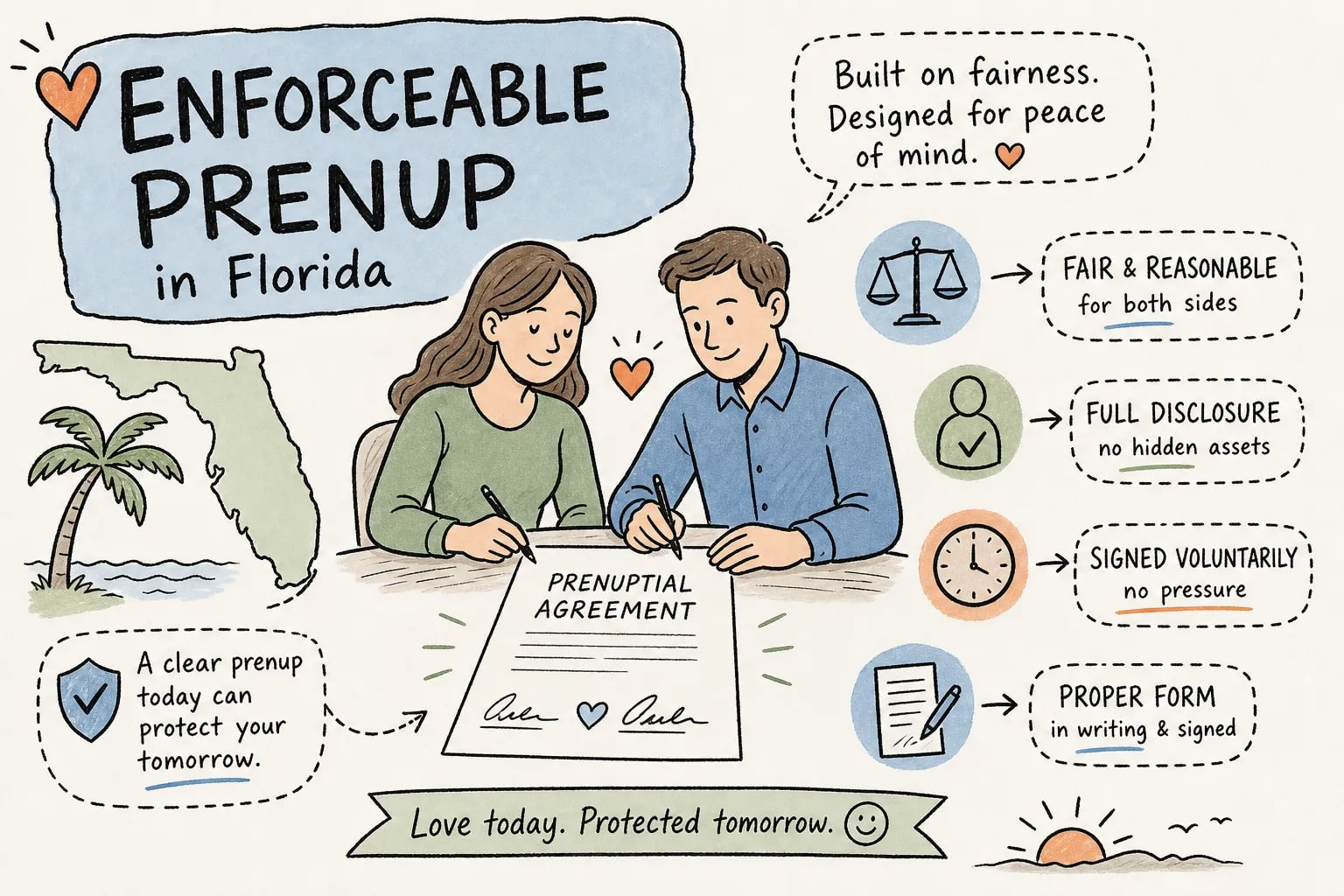
What Makes a Florida Prenuptial Agreement Enforceable
Most people approach a prenuptial agreement in Florida backward. They focus on what to put in it, when the real question is whether it will hold up in court years from now. A Florida prenup that’s never tested is fine. One that gets challenged and thrown out is worse than having nothing, because it gives you false confidence going into a marriage.
Florida has specific statutory requirements for premarital agreements, and courts take them seriously. The formalities matter, and so does the timing. Financial disclosure can make or break enforceability. Dori Shwirtz, a licensed attorney at Divorce Harmony, works with couples on these agreements regularly, so the guidance here comes from what actually happens in practice, not what sounds good in theory. This article covers Florida’s legal requirements, what a prenuptial agreement can and can’t address, the clauses worth including, the mistakes that get agreements voided, and how to get yours done right.
What Florida Law Actually Requires for a Valid Prenuptial Agreement
Florida’s premarital agreement law lives in FL Statute 61.079. The baseline requirements are straightforward: the agreement must be in writing, signed by both parties, and it only becomes effective upon marriage. No separate consideration is required beyond the marriage itself. These aren’t suggestions. They’re the floor.
Writing and Signatures
Notarization and witnesses are not required for validity under the statute, though they’re smart to include as a practical matter because they help establish authenticity if the agreement is challenged later. Some specific provisions, particularly anything touching testamentary rights or inheritance, may trigger additional formality requirements under separate Florida law. When in doubt, over-formalize rather than cut corners.
Voluntariness
The trickier requirement is voluntariness. Even a properly written and signed document can be challenged if one party can demonstrate they didn’t sign it freely. Courts look at the timing of the agreement, whether both parties had adequate time to review it, whether either felt pressured, and whether independent legal counsel was accessible. Signing the week before the wedding isn’t automatically illegal, but it raises serious questions about whether the signing spouse had a genuine choice. That scrutiny is a problem you don’t want.
Full Financial Disclosure
Full financial disclosure is the requirement most couples underestimate. Both parties must provide fair and reasonable disclosure of their assets, debts, and financial obligations before signing. A spouse who was kept in the dark about what they were actually agreeing to has real legal grounds to challenge the agreement later. A written waiver of disclosure is possible, but it’s only valid in narrow circumstances, and courts look closely at whether that waiver was genuinely informed.
What a Prenuptial Agreement in Florida Can and Cannot Cover
Florida law is generous about what a prenup can address. Property classification, debt allocation, spousal support, rights to buy or sell property, life insurance benefits, estate planning arrangements, and business interests are all fair game. Courts will enforce agreements that are financially one-sided, as long as they were validly made. A hard bargain is not the same as an invalid agreement.
On spousal support specifically, Florida law expressly allows a prenup to establish, modify, waive, or eliminate alimony entirely. There is one exception worth knowing: a court can override a spousal support waiver if enforcing it would leave a spouse eligible for public assistance after divorce. Outside that scenario, alimony waivers generally hold.
Business interests deserve their own clause. If either spouse owns a business or professional practice, a prenup can protect that interest, including its goodwill, distributions, and appreciation, from being characterized as marital property during divorce proceedings. The key is being specific about what counts as “separate” appreciation versus appreciation that resulted from marital contributions. Vague language here becomes a dispute later.
Child support is the one area a prenup cannot touch. Florida courts determine child support at the time of the dispute based on the child’s best interests. No agreement signed before children exist can override that. Don’t draft provisions around child support; they won’t hold, and their presence can complicate the rest of the agreement.
It’s also worth noting the distinction between a prenuptial agreement and a postnuptial agreement in Florida. Sometimes called an antenuptial agreement, a prenup is signed before marriage. A postnuptial agreement is executed after the wedding and is governed by somewhat different standards. Both can address property rights and support, but the enforceability analysis differs, and timing relative to the wedding date matters significantly.
The Clauses That Do the Real Work
Property and debt classification language is the core of most Florida prenups. The standard approach is direct: “Each party’s premarital assets and liabilities shall remain that party’s separate property and separate responsibility.” Debt allocation language typically reads something like: “Debts incurred before marriage remain the separate obligation of the spouse who incurred them.” The precision matters because ambiguous language is what gets argued over in court.
Spousal support clauses need to be just as specific. Either the parties are waiving it entirely or they’re setting specific terms. A vague statement that “spousal support will be reasonable” is not enforceable language. Write out the exact terms or the exact waiver. Business protection clauses follow the same logic. A well-drafted clause covers not just the business itself but its appreciation, distributions, and goodwill, and states clearly that no ownership interest arises in the other spouse solely by reason of marriage or indirect contributions.
Passive appreciation of separate property is worth addressing explicitly too. If one spouse owns a rental property before the marriage and it appreciates significantly during the marriage, the prenup should specify whether that appreciation stays separate. Without clear language, that question becomes an argument during divorce proceedings.
Why Florida Courts Throw Out Prenuptial Agreements
The most common pattern is coercion tied to timing. One spouse presents the agreement shortly before the wedding, the other feels they have no real option but to sign, and years later challenges it on the grounds of duress. Courts look at whether the signing spouse had access to independent legal advice, whether they had time to genuinely review and negotiate, and whether the circumstances created real pressure. A prenup handed over 48 hours before the ceremony invites serious scrutiny, even if it isn’t automatically void.
Incomplete financial disclosure is the most common basis for invalidating a Florida prenup. When one spouse fails to disclose assets, understates debts, or provides vague financial information, and the other spouse can demonstrate they had no reasonable way to discover the full picture, the agreement becomes vulnerable. This isn’t a technical procedural issue. It’s a reason a judge can void the entire agreement. The fix is documentation: attach schedules of assets and liabilities with supporting records, and document when the exchange happened.
Unconscionability is the third ground, and it’s worth clarifying. Being one-sided is not enough on its own to get a Florida prenup thrown out. Courts won’t void an agreement just because the terms heavily favor one party. But when an agreement is grossly unfair and paired with inadequate financial disclosure and no written disclosure waiver, courts can find it unconscionable. All three elements need to be present together. Unconscionability as a standalone argument rarely succeeds.
A Step-by-Step Checklist for a Compliant Florida Prenup
- Start early. Begin the process at least three to six months before the wedding. This removes any argument about time pressure or coercion.
- List everything. Each party independently lists all assets, debts, income sources, retirement accounts, and business interests before drafting begins.
- Exchange disclosures in writing. Document the exchange formally. Attach schedules to the agreement as exhibits and keep records of when the exchange occurred.
- Decide what the agreement needs to cover. Identify the specific issues: property classification, spousal support, business protection, debt allocation. Know what you’re drafting before you draft it.
- Work with a licensed Florida attorney. Have the agreement drafted by someone who actually knows FL Statute 61.079 and what Florida courts look for when they review these agreements.
- Both parties review independently. Ideally, each spouse reviews the draft with separate legal counsel. At minimum, each party should have unrushed time to read and question the document.
- Sign well before the wedding. No last-minute signing. Sign the agreement with enough time that neither party can credibly argue they were pressured by the approaching ceremony.
- Store it and revisit it. Keep the executed agreement with your important legal documents. If circumstances change significantly, consult an attorney about whether an amendment or a postnuptial agreement makes sense.
Template or Attorney: What Actually Protects You
A generic prenup template might satisfy the basic writing and signature requirements of FL Statute 61.079. What it won’t do is account for the specifics of your financial situation, produce properly tailored disclosure documentation, or catch the clause language that Florida courts tend to pick apart. A template gives you the appearance of a prenuptial agreement. It doesn’t give you the substance of one.
Many couples assume that hiring a licensed attorney means thousands of dollars in hourly billing and a drawn-out process. That assumption is worth questioning. Dori Shwirtz at Divorce Harmony offers flat-fee prenuptial agreement drafting with one-on-one attention to each couple’s specific situation. You get an attorney who understands Florida premarital agreement law, builds proper financial disclosure documentation, and drafts clause language structured to hold up in court. For a document that needs to protect both of you years from now, that’s a straightforward investment in getting it done correctly.
The Bottom Line on Florida Prenuptial Agreement Enforceability
A prenuptial agreement in Florida is only as strong as its legal foundation. Proper formalities, honest and documented financial disclosure, and precise clause language determine whether your prenup does its job when it matters.
The goal of a prenup isn’t to plan for failure. It’s to give both people clarity and protection going into the marriage. Done right, it’s one of the cleaner conversations two people can have before they get married: here’s what we each have, here’s what we’ve agreed to, and here’s the document that reflects it.
If you’re in Florida and ready to get yours done properly, reach out to Divorce Harmony for a consultation. Working with a licensed attorney who handles these agreements regularly is how you avoid finding out years later that your prenup doesn’t hold up.
Florida Prenuptial Agreement Enforceability: Frequently Asked Questions
Is a prenuptial agreement enforceable in Florida?
Yes, if it meets the requirements of Florida Statute 61.079. The agreement must be in writing, signed by both parties, and it takes effect only upon marriage. It also needs to be entered into voluntarily, with fair and reasonable financial disclosure, and precise clause language.
Does a Florida prenup have to be notarized?
Notarization and witnesses are not required for validity under the statute, but they are smart to include because they help establish authenticity if the agreement is challenged. Provisions that touch inheritance or testamentary rights may trigger additional formalities under separate Florida law.
How far in advance of the wedding should a prenup be signed?
Start the process at least three to six months before the wedding, and sign well before the ceremony. A prenup handed over just days before the wedding invites scrutiny over whether the signing spouse had a genuine choice, even though it is not automatically void.
What makes a Florida prenup invalid?
The most common grounds are incomplete financial disclosure, coercion or duress tied to last-minute timing, and unconscionability. A one-sided agreement is not enough on its own to be thrown out, but a grossly unfair agreement paired with inadequate disclosure and no written disclosure waiver can be found unconscionable.
Can a prenup waive alimony in Florida?
Yes. Florida law allows a prenup to establish, modify, waive, or eliminate alimony. The main exception is that a court can override a waiver if enforcing it would leave a spouse eligible for public assistance after the divorce.
Can a prenup decide child support?
No. Florida courts determine child support at the time of the dispute based on the child's best interests, and a prenup cannot override that. Drafting provisions around child support will not hold up and can complicate the rest of the agreement.
Do both spouses need their own attorney?
Florida's statute does not strictly require it, but it is strongly advisable. Each spouse should ideally review the draft with separate legal counsel. At a minimum, each party should have unrushed time to read and question the document, because access to independent advice is one of the factors courts look at when voluntariness is challenged.
What is the difference between a prenup and a postnup in Florida?
A prenup is signed before the wedding and a postnuptial agreement is signed after it. Both can address property rights and support, but they are governed by somewhat different standards, so the enforceability analysis differs and timing relative to the wedding date matters.
Is a prenup template enough in Florida?
A template may satisfy the basic writing and signature requirements, but it will not account for the specifics of your finances, produce tailored disclosure documentation, or catch clause language Florida courts tend to challenge. Working with a licensed Florida attorney is the safer route.