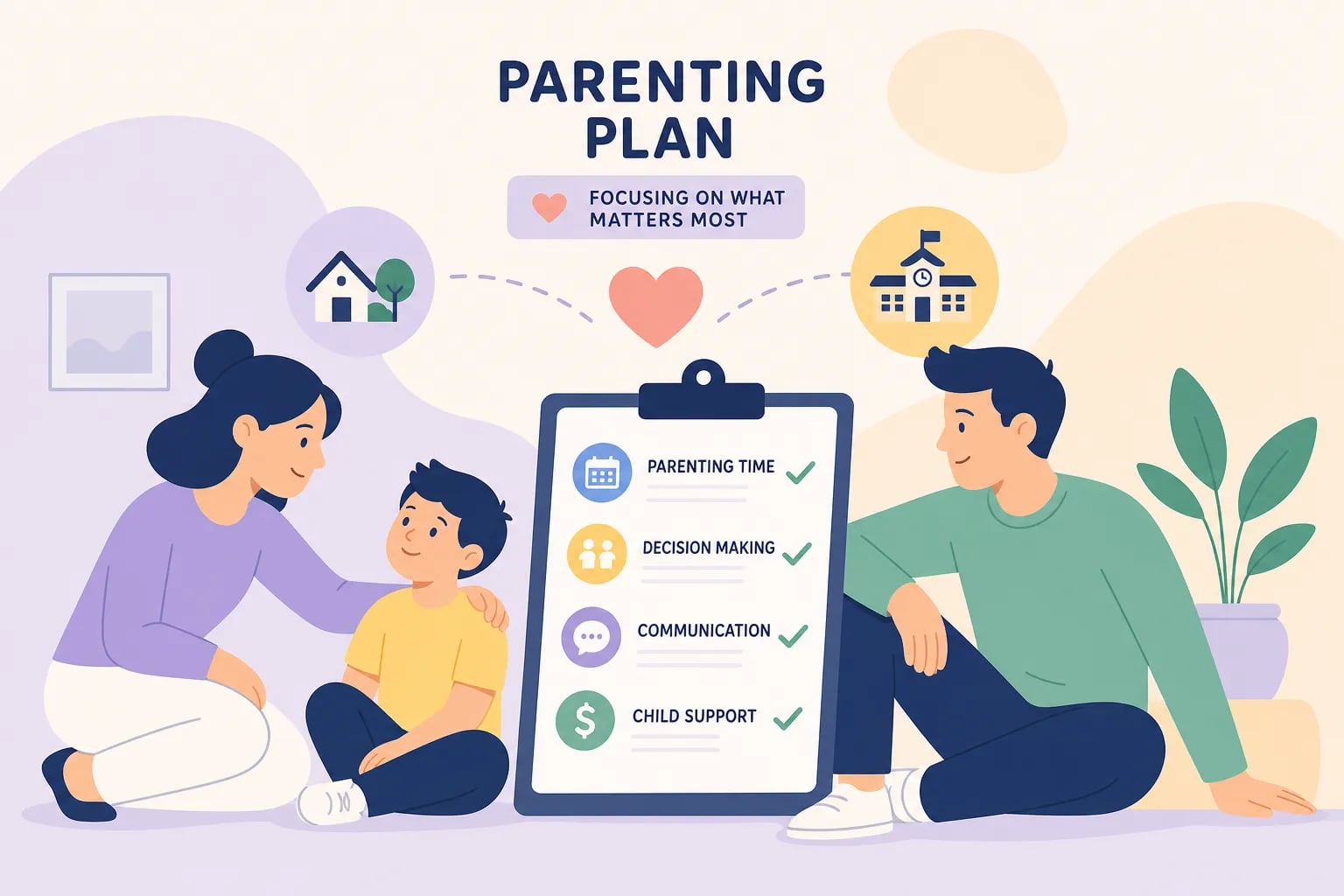
What Is a Parenting Plan in Florida? What It Includes and How It Works
What is a parenting plan in Florida? When parents going through a Florida divorce sit down to figure out custody, they quickly discover that the Florida parenting plan is not a one-page summary of good intentions. Drafting a parenting plan for a Florida divorce means producing a detailed legal document that controls where your child sleeps, who makes medical decisions, and how holidays are divided for years to come. Florida courts require every divorce involving minor children to include a court-approved parenting plan, and judges take that requirement seriously. Under Florida Statutes § 61.13, judges routinely reject or return vague agreements and plans that leave critical decisions unresolved.
This article covers five things every parent needs to understand before filing: what the law actually mandates, how to write a time-sharing schedule that holds up, who gets to make major decisions, which form fits your situation, and what gets a plan rejected or dragged back to court. If you walk away knowing these five areas, you’re already ahead of most people who try to navigate this process alone.
What Florida Law Actually Requires in Every Parenting Plan
Florida Statutes § 61.13(2)(b) is the controlling law, and it’s unambiguous: a court-approved parenting plan is required in any divorce involving minor children. If the parents can’t agree on one, the court creates it. “We’ll work it out later” is not language that satisfies a Florida judge, and submitting a plan without the required elements will get it returned for revision before a judge ever signs it.
The Five Things Every Florida Parenting Plan Must Include
The statute identifies five non-negotiable elements that every parenting plan in a Florida divorce must address:
- Daily upbringing: The plan must describe in adequate detail how the parents will share responsibility for the child’s daily upbringing.
- Time-sharing schedule: It must include a specific schedule showing when the child is with each parent.
- Health care: It must designate who is responsible for all forms of health care.
- School-related matters: It must address which parent’s address is used for school-boundary determination and registration.
- Parent-child communication: It must describe the methods and technology each parent will use to communicate with the child when the child is with the other parent.
Vague language on any of these five points is grounds for rejection.
What Courts Also Want to See Beyond the Minimum
A plan that only hits the statutory minimums leaves room for future disputes that bring families back to court. Florida family law practitioners consistently find that comprehensive plans hold up better over time, so judges look favorably on plans that also address:
- Holiday and vacation schedules
- Transportation and exchange locations
- Parent-to-parent communication methods
- Access to medical and school records
- Extracurricular activity procedures
- Travel notice requirements
Every ambiguity you leave in the plan today becomes a potential conflict in front of a judge later. Addressing these details upfront is far less expensive than returning to court to resolve them after the fact.
How to Structure a Time-Sharing Schedule That Holds Up
Time-sharing is the part of the plan most parents focus on, and it’s also the part most likely to be rejected when drafted poorly. Florida courts require specific schedules, not general intentions. A plan that says “reasonable visitation” gives a judge nothing enforceable and is likely to be returned for revision under the specificity requirements of § 61.13.
Standard Weekly Schedules and How to Make Them Specific
The most common structures are the alternating-week (7/7) plan, where each parent has the children for a full week before exchanging, and the every-other-weekend plan, where one parent has primary residence and the other has the children from Friday after school through Monday morning. A 2-2-3 rotation, Parent A has Monday and Tuesday, Parent B has Wednesday and Thursday, and the weekend alternates, keeps both parents involved on a frequent basis. Whatever schedule you choose, the plan must specify exact days, times, pickup and drop-off locations, and who provides transportation. Form 12.995(a), the Basic Parenting Plan, structures weekly time-sharing with this level of detail as its baseline, though specifics may vary by circuit.
Holiday, Summer, and School-Break Allocation
Holidays are typically alternated by year: Thanksgiving in odd years with one parent, even years with the other. Winter break is often split at a specific date and time rather than left to negotiation. Summer vacation usually gives each parent a block of uninterrupted time, often two weeks. Plans must specify exact start and end times for each holiday period, including spring break and three-day weekend holidays like Memorial Day and Labor Day. For long-distance parents, extended blocks during school breaks replace weekly exchanges entirely, and the plan must address transportation costs and notice requirements for out-of-state travel at least 30 days in advance.
Parental Responsibility: Who Actually Makes the Major Decisions
Time-sharing tells you where the child sleeps. Parental responsibility tells you who makes the decisions that shape the child’s life. These are two separate legal concepts, and confusing them is one of the more common mistakes parents make when drafting their Florida parenting plan. Understanding the distinction before you start writing saves significant revision time.
Shared vs. Sole Parental Responsibility Explained
Shared parental responsibility is the Florida default. It means both parents confer and jointly decide on major matters affecting the child, including education, health care, and general welfare decisions. Sole parental responsibility is reserved for cases where shared decision-making would be detrimental to the child, typically in situations involving domestic violence, abuse, or a chronic inability to co-parent. Under § 61.13, the court presumes shared responsibility serves the child’s best interests unless evidence shows otherwise. Your plan needs to state clearly which type applies and how decision-making works in practice.
What the Plan Must Say About Education, Medical Care, and Emergencies
The plan must name which parent’s address is used for school-boundary determination, how each parent accesses medical and dental records, who approves elective procedures, and how emergency medical decisions are handled when the other parent can’t be reached. These are not optional details. Omitting them is one of the top reasons plans get returned for revision. A judge reviewing your plan needs to see that a third party could read the document and know exactly what happens in any common scenario, without the parents needing to negotiate in the moment.
Choosing the Right Florida Parenting Plan Form for Your Divorce
Florida provides three official parenting plan forms, and using the wrong one creates unnecessary complications. Choosing the right form before you start drafting saves time and avoids having to rework a completed document. It also signals to the court that you understand the process, which matters when a judge is deciding how much scrutiny to give your submission.
Florida Parenting Plan Form 12.995(a), (b), and (c): Which One Applies to Your Situation
Form 12.995(a) is the standard form for most divorces involving minor children. It covers parental responsibility, weekly time-sharing, holidays, health care, education, and communication. Form 12.995(b) is the safety-focused version used when supervised time-sharing or domestic violence concerns are present; it includes provisions for supervision requirements, no-firearm conditions, and protective exchange procedures. Form 12.995(c) addresses relocation and long-distance situations, where frequent exchanges are impractical and the child lives primarily with one parent during the school year. All three forms are available on the Florida Courts website, with official instructions included in the same document.
The Four Plan Templates and When Each Fits Your Family
Some circuits, including the Twelfth Judicial Circuit, formally approve four local template types: Basic, Long-Distance, Highly Structured, and Safety-Focused. The Basic template works for parents who cooperate reasonably well and need a standard weekly schedule. The Highly Structured template is designed for high-conflict situations; it specifies exact exchange times, requires a designated neutral exchange location, and may limit parent communication to a designated app with a defined response window, though the exact provisions vary by circuit and should be confirmed against your local template. The Safety-Focused template mirrors Form 12.995(b) with supervised visitation provisions. The Long-Distance template handles extended blocks during school breaks for parents who live far apart. Always check your specific circuit’s website for local variations before filing, because a template approved in one circuit isn’t automatically accepted in another.
What Gets a Parenting Plan Rejected or Later Modified
Courts reject or revise parenting plans for predictable reasons, and understanding those reasons before you draft saves you the delay and frustration of starting over. The same mistakes that cause initial rejection also tend to generate post-divorce litigation.
The Drafting Mistakes That Send Plans Back to Square One
Vague language is the fastest route to rejection. Phrases like “reasonable visitation,” “the parents will agree later,” or “liberal time-sharing” give a judge nothing enforceable. Missing the school-boundary address designation is another consistent problem; Florida plans must identify which parent’s address determines the child’s school assignment. Tying parenting time to child support payments is an error that Florida courts reject outright, parenting time and support are separate legal obligations, and conditioning one on the other is not permitted. Omitting holiday detail and leaving blank sections on required topics will also result in an administrative return before the plan ever reaches a judge.
How Courts Evaluate Whether Your Plan Serves the Child
The “best interests of the child” standard governs every judicial review. Courts look at stability, each parent’s ability to honor the schedule and support the child’s relationship with the other parent, school continuity, health care access, geographic feasibility, and whether the plan is workable given how these specific parents actually communicate. A plan that looks clean on paper but requires constant coordination between parents who can’t speak civilly will be revised. Florida also generally presumes that equal time-sharing serves the child’s best interests, so a substantially unequal schedule needs factual support. Modification after a plan is approved requires proving a substantial, material, and unanticipated change in circumstances, a high legal bar that makes getting the plan right the first time genuinely worth the effort.
How to Get Your Parenting Plan Finalized Without a Courtroom Battle
Agreeing on a parenting plan outside of court is almost always faster, cheaper, and more durable than having a judge impose one. Understanding the filing mechanics and the role mediation can play makes the process significantly less stressful.
Filing Your Plan: Signatures, Notarization, and Required Attachments
An agreed parenting plan must be signed by both parents before a notary public before it can be filed. The original is filed with the clerk of the circuit court using the existing divorce case number. When filing, the plan must be accompanied by the UCCJEA Affidavit (Form 12.902(d)), the Notice of Social Security Number (Form 12.902(j)), a Family Law Financial Affidavit, and a Child Support Guidelines Worksheet. Filing fees to open a divorce case generally run around $400, though the exact amount varies by county. The Florida Courts E-Filing Portal is an option in most counties for submitting documents electronically. After filing, the court will review the plan, do not treat a filed plan as a final order until a judge has signed it and it is incorporated into the final judgment.
The Mediation Path to a Plan Both Parents Actually Follow
Parents who build their parenting plan through mediation tend to produce more detailed, practical, and durable agreements. The reason is straightforward: they created the plan themselves, with professional guidance, rather than having terms imposed by a judge who spent a limited amount of time reviewing a contested case. Working through a mediator gives parents the space to address real-life logistics that a courtroom process often misses, from school pickup routines to how sick days are handled.
For parents who want that kind of structured support, Divorce Harmony offers online mediation services led by Dori Shwirtz, a Florida Supreme Court Certified Mediator, licensed attorney, and divorce coach. Dori guides parents through the full parenting plan process entirely online, helping them reach a court-ready agreement without stepping into a courtroom. For families who want professional guidance from the initial session through final filing, this approach helps ensure the plan you submit reflects what your family actually needs.
Getting Your Florida Parenting Plan Approved the First Time
A parenting plan for a Florida divorce is a detailed legal document with specific statutory requirements under § 61.13. The form and template you choose matter for your situation, and vague language remains the single fastest route to rejection or future conflict. Parents who approach the plan collaboratively, through mutual agreement or professional mediation, often reach faster judicial approval and experience fewer post-divorce disputes than those who let the process become adversarial, according to family law practitioners and research on mediated agreements.
If you and your co-parent are ready to build a time-sharing and decision-making plan that a Florida court will approve without the expense of competing attorneys, reach out to Divorce Harmony for a free initial consultation. Dori Shwirtz will assess your situation, explain which form applies to your case, and walk you through every section of the plan so nothing gets left out, so the parenting plan you file is one a judge can sign without sending it back.
Florida Parenting Plan FAQs
Quick answers to the questions Florida parents ask most about parenting plans, time-sharing, and getting a plan approved by the court.
Is a parenting plan required in a Florida divorce?
Yes. Under Florida Statutes § 61.13(2)(b), every divorce involving minor children must include a court-approved parenting plan. If the parents cannot agree on one, the court will create it for them.
What must a Florida parenting plan include?
Florida law requires every parenting plan to address five elements:
- Daily upbringing: how the parents will share responsibility for the child's day-to-day life.
- Time-sharing schedule: a specific schedule showing when the child is with each parent.
- Health care: who is responsible for all forms of health care.
- School matters: which parent's address is used for school-boundary determination and registration.
- Parent-child communication: the methods and technology each parent will use to communicate with the child during the other parent's time.
Courts also look favorably on plans that cover holidays, vacations, transportation, exchange locations, records access, extracurricular activities, and travel notice.
What is the difference between time-sharing and parental responsibility?
Time-sharing determines where the child lives and when. Parental responsibility determines who makes major decisions about the child's education, health care, and general welfare. They are two separate legal concepts, and your plan needs to address both clearly.
What is shared parental responsibility in Florida?
Shared parental responsibility is the Florida default. Both parents confer and jointly decide major matters affecting the child. Sole parental responsibility is reserved for cases where shared decision-making would be harmful to the child, such as situations involving domestic violence, abuse, or a chronic inability to co-parent.
What are the most common time-sharing schedules?
Common Florida schedules include the alternating-week (7/7) plan, the every-other-weekend plan, and the 2-2-3 rotation, which keeps both parents involved throughout the week. Whatever schedule you choose, the plan must list exact days, times, pickup and drop-off locations, and who provides transportation. Phrases like "reasonable visitation" are not specific enough.
Which Florida parenting plan form should I use?
- Form 12.995(a): the standard parenting plan for most divorces with minor children.
- Form 12.995(b): the safety-focused plan for supervised time-sharing or domestic violence concerns.
- Form 12.995(c): the relocation and long-distance plan for parents who live far apart.
All three are available on the Florida Courts website. Some circuits also have their own approved templates, so check your local circuit before filing.
Why do Florida courts reject parenting plans?
The most common reasons are vague language (such as "the parents will agree later"), failing to name which parent's address is used for school assignment, leaving required sections blank, missing holiday details, and tying parenting time to child support payments. Florida treats parenting time and child support as separate obligations, so one cannot be conditioned on the other.
Does Florida presume equal time-sharing?
Florida generally presumes that equal time-sharing is in the child's best interests. A substantially unequal schedule needs factual support showing why it better serves the child.
Does a Florida parenting plan need to be notarized?
Yes. An agreed parenting plan must be signed by both parents before a notary public. It is then filed with the clerk of the circuit court under your divorce case number, along with required forms such as the UCCJEA Affidavit, Notice of Social Security Number, Family Law Financial Affidavit, and Child Support Guidelines Worksheet. The plan is not final until a judge signs it and it is incorporated into the final judgment.
Can a parenting plan be changed after the divorce?
Yes, but it is difficult. To modify an approved plan, a parent must prove a substantial, material, and unanticipated change in circumstances. Because that bar is high, it pays to get the plan right the first time.
Can mediation help us create a parenting plan?
Yes. Parents who build their plan through mediation tend to create more detailed, practical, and lasting agreements, usually faster and for less cost than a contested case. Divorce Harmony offers online mediation led by Dori Shwirtz, a Florida Supreme Court Certified Mediator, licensed attorney, and divorce coach, who guides parents through every section of a court-ready parenting plan.