Is Divorce Mediation Better Than a Lawyer in Florida?
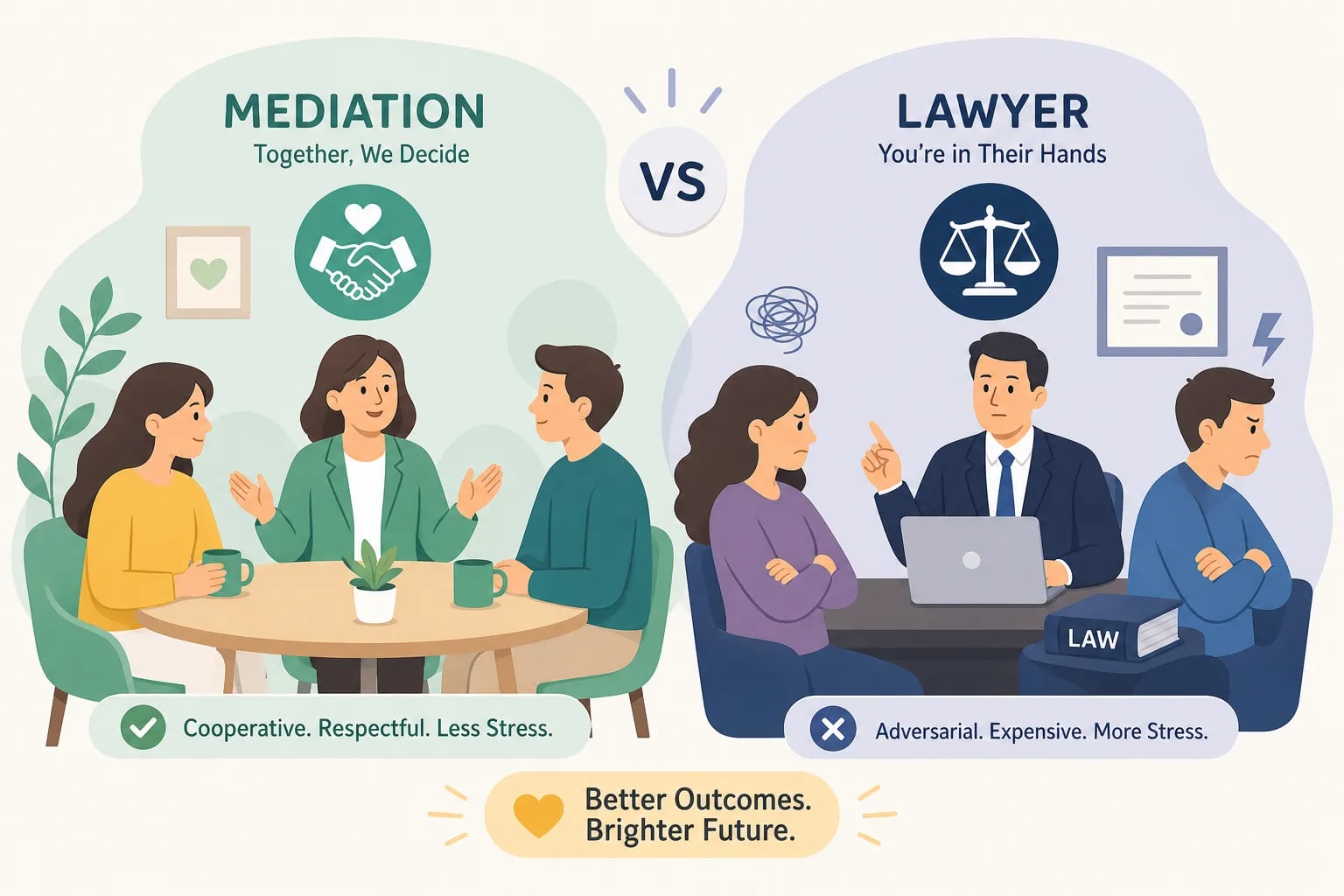
Is divorce mediation better than hiring a lawyer in Florida? That is one of the first real questions couples face when a marriage ends, and it deserves a direct answer rather than a vague “it depends.” One path leads toward mediation; the other leads toward hiring an attorney. Choosing the wrong path costs money, time, and emotional energy that couples going through divorce simply cannot afford to waste. Both mediation and attorney representation are legitimate options that serve real needs. The challenge is that most people pick a path based on whoever they happen to call first, not based on what actually fits their situation.
This article gives you a straightforward comparison: what each option costs in real numbers, how long each takes, when mediation is the right call and when it is not, and how a mediated agreement becomes just as legally binding as a court order. Divorce Harmony, led by licensed Florida attorney and Florida Supreme Court Certified Mediator Dori Shwirtz, exists precisely because most people benefit from understanding both paths before committing to either. Read this first, then decide.
Is Divorce Mediation Better Than Hiring a Lawyer in Florida? Key Differences
What the mediation process looks like step by step
Divorce mediation is a structured negotiation guided by a neutral third party who does not decide anything for you. The mediator’s job is to help both spouses reach their own resolution on property division, spousal support, and parenting arrangements if children are involved. Florida family law mediation is governed by Rules 12.740 and 12.741 of the Florida Family Law Rules of Procedure, and mediators must meet Florida Supreme Court certification requirements to handle court-referred cases. Most sessions run two to four hours, and many cases resolve in one to three sessions.
The key word in mediation is “facilitated.” A certified mediator does not advocate for either spouse. The mediator structures the conversation, flags areas of disagreement, and helps the parties find workable compromises. That neutrality is both mediation’s greatest strength and its primary limitation, depending on your situation.
What attorney representation involves in a contested divorce
Hiring a divorce attorney means retaining a professional whose job is to advocate exclusively for your interests. Your attorney handles filings, negotiates with opposing counsel, conducts discovery, and represents you in court hearings. In a contested Florida divorce, this involves formal procedures: interrogatories, depositions, motions, and potentially a trial. The process is adversarial by design, which is appropriate when the circumstances call for it.
In litigation, decision-making authority shifts away from you and toward lawyers and, ultimately, a judge. If you and your spouse cannot reach agreement through negotiation, a judge decides the outcome. That shift in control shapes everything from cost to timeline to how you and your co-parent relate to each other afterward.
Who controls the outcome in each approach
In mediation, both spouses drive the agreement together. In litigation, a judge holds final authority if the parties cannot settle on their own. Readers who have strong preferences about specific property terms, parenting schedules, or support arrangements will find this distinction matters far more than they initially expect. An agreement you built yourself is also one you are more likely to follow without future conflict.
What you’ll actually spend on each path
Costs: Is Divorce Mediation Better Than Hiring a Lawyer in Florida?
Private divorce mediation in Florida in 2026 typically runs $150 to $400 per hour, with most experienced certified family mediators clustered between $250 and $350 per hour. Total case costs for both spouses combined generally fall between $3,000 and $8,000, often split equally. Flat-fee mediation for straightforward cases can run as low as $1,500 to $3,000, which makes the all-in cost predictable from the start. Court-connected mediation is significantly cheaper, around $60 to $120 per person per session, based on household income.
Even at the higher end of private mediation rates, the math is manageable. A mediator charging $350 per hour working through a four to six hour process totals $1,400 to $2,100 in mediator fees. Split equally between both spouses, each party pays roughly $700 to $1,050. That is a number you can budget for before the first session begins.
What a contested divorce with attorneys typically costs
Florida divorce attorneys in major markets charge $300 to $600 per hour, with complex-case specialists running higher. A contested case moving toward litigation commonly costs $15,000 to $30,000 or more per spouse. Note that figure is per spouse, not combined. If both parties hire counsel, the household is spending $30,000 to $60,000 in attorney fees before accounting for expert witnesses, forensic accountants, or custody evaluators.
Even an “uncontested” divorce where both spouses hire separate attorneys involves two attorney fee bills. The moment a case requires contested motions, discovery disputes, or hearings, that meter accelerates quickly.
The hidden cost factors that push attorney fees higher
Contested custody disputes, business valuations, allegations of hidden assets, and discovery delays all multiply billable hours in ways that are genuinely difficult to predict at the start. Every motion filed by one attorney typically requires a response from the other, and each response costs money on both sides. Mediation, by contrast, runs on a session-based cost structure. You know the mediator’s hourly rate before you begin, and you control how prepared and focused each session is.
How long each path takes to finalize your divorce
Typical mediation timelines from first session to signed agreement
When both spouses arrive prepared and willing to negotiate, Florida divorce mediation commonly wraps up in 30 to 60 days from the first session to a signed agreement. A more realistic typical range for cases with moderate complexity is two to four months, accounting for scheduling, follow-up sessions, and document preparation. Florida Family Law Rule 12.740 sets an expectation that court-referred mediation generally completes within 75 days of the first session. After signing, paperwork processing and final judgment entry typically adds another one to four weeks.
Why contested litigation drags on for months, sometimes over a year
Contested Florida divorces commonly take 9 to 18 months to finalize. High-conflict cases involving custody battles, business assets, or ongoing discovery disputes can stretch to 24 months or longer. Court scheduling, mandatory waiting periods, motion practice, and opposing counsel availability all contribute to that timeline. Each scheduled court date typically pushes the next step out by several weeks, and a case that was expected to resolve in six months can drift into its second year without any single dramatic event causing the delay.
What the timeline difference means for daily life
A two to four month resolution versus a 12 to 18 month process is not just a scheduling difference. It affects financial planning, housing decisions, co-parenting logistics, and emotional recovery. For anyone with shared financial obligations or children requiring stable arrangements, speed to resolution has practical consequences that compound over time. Every month a divorce drags on is another month of legal fees, shared financial entanglement, and unresolved uncertainty.
When mediation works well and when it doesn’t
Situations where mediation consistently produces good outcomes
Mediation works well when both spouses are willing to communicate in good faith and marital assets and debts are reasonably transparent, with neither party holding a significant information advantage over the other. It is especially effective for couples with minor children who want to maintain a functional co-parenting relationship after the divorce, for those with straightforward financial situations, and for anyone who wants meaningful control over the final terms of their settlement. The collaborative nature of the process also tends to produce agreements that both parties respect and follow without future conflict.
Red flags that make mediation risky or inappropriate
Mediation is not the right fit for every situation. Domestic violence, coercive control, or a serious power imbalance can make voluntary negotiation unsafe or fundamentally unfair. Florida Statute 44.102 explicitly addresses this: courts may withhold a mediation referral when a history of domestic violence would compromise the process. An injunction alone is not sufficient to trigger that protection; the court evaluates whether the specific history would actually undermine fair negotiation.
Hidden assets present a separate but equally serious problem. Mediation depends on honest financial disclosure from both parties. If one spouse is concealing accounts, income, or business interests, any agreement reached will not reflect the actual marital estate, and you may be giving up rights you do not know you have. Situations requiring urgent court intervention, such as asset freezes, protective orders, or immediate custody protections, also fall outside what mediation can address.
What to do when these red flags apply
When mediation is inappropriate, hiring an attorney with litigation experience is the right call. Discovery tools, subpoenas, forensic accountants, and emergency court orders are available in litigation that simply do not exist in mediation. This is not a failure of the mediation process; it is the process functioning correctly by recognizing its own appropriate limits. Knowing when not to mediate is just as important as knowing when to use it.
How a mediated agreement becomes legally binding in Florida
What makes the signed agreement enforceable
Once both spouses sign a written mediated settlement agreement, that document carries real legal weight. Under Florida Statute 44.405, a signed written agreement reached during mediation is not confidential, meaning it can be introduced in court to prove or enforce the terms. Florida courts have consistently treated properly executed mediation agreements as binding contracts, subject to standard contract law defenses if later challenged. The governing framework includes two primary sources: F.S. section 44.102, which covers court referral authority, and Rules 12.740 and 12.741 of the Florida Family Law Rules of Procedure, which govern mediator selection, process requirements, and dispute handling.
How the agreement gets incorporated into the final divorce judgment
After signing, the parties file the mediated settlement agreement with the court. The judge reviews it for compliance with Florida law and, for cases involving minor children, must specifically confirm that the parenting plan serves the child’s best interest before approving it. If approved, the agreement is incorporated into the Final Judgment of Dissolution of Marriage. At that point, the divorce is legally final and the agreement terms carry the full force of a court order. Choosing mediation does not mean accepting a less enforceable outcome; a mediated agreement properly filed and incorporated is court-ordered and fully enforceable.
Choosing the right path for your Florida divorce
Questions to ask before committing to either option
Before defaulting to either mediation or litigation, run through a practical self-assessment. Is your spouse willing to negotiate openly and honestly? Do you have a clear, complete picture of all marital assets? Are there any safety concerns that would make face-to-face negotiation unsafe? How quickly do you need this resolved, and what are the financial and logistical costs of delay? Does your situation involve custody complexity that requires specific legal protections for your children? Your honest answers to these questions will do more to guide your decision than any general rule of thumb.
Why having both options available in one place changes the equation
Most people entering a Florida divorce do not know in advance whether they need mediation, full attorney representation, or a combination of both at different stages. When a certified mediator and a licensed attorney are available through the same service, the approach can be matched to the actual situation rather than defaulted to whatever a single-track professional offers. It also means that if mediation reveals a problem requiring legal intervention, there is no gap in coverage and no need to start over with a new professional. For Florida residents weighing divorce mediation versus hiring a lawyer in Florida, that continuity has real practical value.
How Divorce Harmony approaches this decision with clients
Divorce Harmony, led by Dori Shwirtz, offers both certified mediation and full legal document preparation under one roof. Clients start with a free consultation to assess which path fits their specific situation. For couples who can reach agreement, the mediation and filing process can finalize an uncontested divorce in as little as 30 days in straightforward cases, often without requiring a court appearance. For situations that require legal guidance before or alongside mediation, that expertise is available in the same conversation. This is a meaningfully different model from hiring a litigator focused on contested proceedings, or from using a document preparation service with no legal authority to advise you at all.
The bottom line on mediation vs. attorneys in Florida
Mediation is faster, cheaper, and more collaborative for couples who are both willing and prepared to negotiate in good faith. Attorney representation is the right choice when safety concerns, hidden assets, or high-conflict circumstances make fair voluntary negotiation impossible. The legal framework in Florida fully supports mediated agreements as enforceable outcomes, so choosing mediation does not mean sacrificing legal protection. It means building your own agreement under professional guidance and having it incorporated into a binding court order.
Ultimately, whether divorce mediation is better than hiring a lawyer in Florida comes down to the specifics of your situation, not a one-size-fits-all answer. If you are not sure which category your divorce falls into, that uncertainty is exactly what a free consultation is designed to resolve. Schedule your free consultation with Divorce Harmony to get a clear answer before committing to either path, no cost, no commitment, just professional clarity when you need it most.
Is Divorce Mediation Better Than a Lawyer in Florida?
That's one of the first real questions couples face when a marriage ends, and it deserves a direct answer rather than a vague "it depends." Both mediation and attorney representation are legitimate options that serve real needs -- the challenge is that most people pick a path based on whoever they happen to call first, not based on what actually fits their situation.
Below is a straightforward, question-by-question breakdown: real costs, real timelines, when mediation is the right call, when it isn't, and how a mediated agreement becomes just as legally binding as a court order.
How Mediation and Litigation Work
Divorce mediation is a structured negotiation guided by a neutral third party who does not decide anything for you. The mediator's job is to help both spouses reach their own resolution on property division, spousal support, and parenting arrangements if children are involved.
Florida family law mediation is governed by Rules 12.740 and 12.741 of the Florida Family Law Rules of Procedure, and mediators must meet Florida Supreme Court certification requirements to handle court-referred cases. Most sessions run two to four hours, and many cases resolve in one to three sessions.
The key word is "facilitated." A certified mediator does not advocate for either spouse -- they structure the conversation, flag areas of disagreement, and help both parties find workable compromises. That neutrality is both mediation's greatest strength and its primary limitation, depending on your situation.
Hiring a divorce attorney means retaining a professional whose job is to advocate exclusively for your interests. Your attorney handles filings, negotiates with opposing counsel, conducts discovery, and represents you in court hearings.
In a contested Florida divorce, this involves formal procedures: interrogatories, depositions, motions, and potentially a trial. The process is adversarial by design, which is appropriate when the circumstances call for it. In litigation, decision-making authority shifts away from you and toward lawyers and, ultimately, a judge -- if you and your spouse cannot reach agreement through negotiation, a judge decides the outcome.
In mediation, both spouses drive the agreement together. In litigation, a judge holds final authority if the parties cannot settle on their own.
This distinction matters far more than most people expect going in -- especially if you have strong preferences about specific property terms, parenting schedules, or support arrangements. An agreement you built yourself is also one you're more likely to follow without future conflict.
What Each Path Costs
Most experienced certified family mediators cluster between $250 and $350 per hour. Court-connected mediation is significantly cheaper -- around $60 to $120 per person per session, based on household income.
Even at the higher end of private mediation rates, the math is manageable: a mediator charging $350/hour working through a four-to-six-hour process totals $1,400 to $2,100 in mediator fees. Split equally, each party pays roughly $700 to $1,050 -- a number you can budget for before the first session begins.
Note that the per-spouse figure is not combined -- if both parties hire counsel, the household is spending $30,000 to $60,000 in attorney fees before accounting for expert witnesses, forensic accountants, or custody evaluators.
Even an "uncontested" divorce where both spouses hire separate attorneys involves two attorney fee bills. The moment a case requires contested motions, discovery disputes, or hearings, that meter accelerates quickly.
Contested custody disputes, business valuations, allegations of hidden assets, and discovery delays all multiply billable hours in ways that are genuinely difficult to predict at the start. Every motion filed by one attorney typically requires a response from the other, and each response costs money on both sides.
Mediation, by contrast, runs on a session-based cost structure -- you know the mediator's hourly rate before you begin, and you control how prepared and focused each session is.
How Long Each Path Takes
When both spouses arrive prepared and willing to negotiate, Florida divorce mediation commonly wraps up in 30 to 60 days from the first session to a signed agreement. A more realistic range for cases with moderate complexity is two to four months, accounting for scheduling, follow-up sessions, and document preparation.
Florida Family Law Rule 12.740 sets an expectation that court-referred mediation generally completes within 75 days of the first session. After signing, paperwork processing and final judgment entry typically adds another one to four weeks.
Contested Florida divorces commonly take 9 to 18 months to finalize. High-conflict cases involving custody battles, business assets, or ongoing discovery disputes can stretch to 24 months or longer.
Court scheduling, mandatory waiting periods, motion practice, and opposing counsel availability all contribute to that timeline. Each scheduled court date typically pushes the next step out by several weeks, and a case expected to resolve in six months can drift into its second year without any single dramatic event causing the delay.
A two-to-four-month resolution versus a 12-to-18-month process is not just a scheduling difference. It affects financial planning, housing decisions, co-parenting logistics, and emotional recovery.
For anyone with shared financial obligations or children requiring stable arrangements, speed to resolution has practical consequences that compound over time -- every month a divorce drags on is another month of legal fees, shared financial entanglement, and unresolved uncertainty.
When Mediation Works -- and When It Doesn't
Mediation works well when both spouses are willing to communicate in good faith and marital assets and debts are reasonably transparent, with neither party holding a significant information advantage over the other.
- Couples with minor children who want to maintain a functional co-parenting relationship after divorce
- Those with straightforward financial situations
- Anyone who wants meaningful control over the final terms of their settlement
The collaborative nature of the process also tends to produce agreements that both parties respect and follow without future conflict.
Domestic violence, coercive control, or a serious power imbalance can make voluntary negotiation unsafe or fundamentally unfair. Florida Statute 44.102 explicitly addresses this: courts may withhold a mediation referral when a history of domestic violence would compromise the process. An injunction alone is not sufficient to trigger that protection -- the court evaluates whether the specific history would actually undermine fair negotiation.
Hidden assets present a separate but equally serious problem. Mediation depends on honest financial disclosure from both parties. If one spouse is concealing accounts, income, or business interests, any agreement reached will not reflect the actual marital estate -- and you may be giving up rights you don't know you have.
Situations requiring urgent court intervention -- asset freezes, protective orders, or immediate custody protections -- also fall outside what mediation can address.
When mediation is inappropriate, hiring an attorney with litigation experience is the right call. Discovery tools, subpoenas, forensic accountants, and emergency court orders are available in litigation that simply don't exist in mediation.
How a Mediated Agreement Becomes Legally Binding
Once both spouses sign a written mediated settlement agreement, that document carries real legal weight. Under Florida Statute 44.405, a signed written agreement reached during mediation is not confidential, meaning it can be introduced in court to prove or enforce its terms.
Florida courts have consistently treated properly executed mediation agreements as binding contracts, subject to standard contract law defenses if later challenged. The governing framework includes two primary sources: F.S. section 44.102 (court referral authority) and Rules 12.740 and 12.741 of the Florida Family Law Rules of Procedure (mediator selection, process requirements, and dispute handling).
After signing, the parties file the mediated settlement agreement with the court. The judge reviews it for compliance with Florida law and, for cases involving minor children, must specifically confirm that the parenting plan serves the child's best interest before approving it.
If approved, the agreement is incorporated into the Final Judgment of Dissolution of Marriage. At that point, the divorce is legally final and the agreement terms carry the full force of a court order.
Choosing the Right Path
Run through a practical self-assessment before defaulting to either path:
- Is your spouse willing to negotiate openly and honestly?
- Do you have a clear, complete picture of all marital assets?
- Are there any safety concerns that would make face-to-face negotiation unsafe?
- How quickly do you need this resolved, and what are the financial and logistical costs of delay?
- Does your situation involve custody complexity that requires specific legal protections for your children?
Your honest answers to these questions will do more to guide your decision than any general rule of thumb.
Most people entering a Florida divorce don't know in advance whether they need mediation, full attorney representation, or a combination of both at different stages. When a certified mediator and a licensed attorney are available through the same service, the approach can be matched to the actual situation rather than defaulted to whatever a single-track professional offers.
It also means that if mediation reveals a problem requiring legal intervention, there's no gap in coverage and no need to start over with a new professional.
Divorce Harmony, led by licensed Florida attorney and Florida Supreme Court Certified Mediator Dori Shwirtz, offers both certified mediation and full legal document preparation under one roof. Clients start with a free consultation to assess which path fits their specific situation.
For couples who can reach agreement, the mediation and filing process can finalize an uncontested divorce in as little as 30 days in straightforward cases, often without requiring a court appearance. For situations that require legal guidance before or alongside mediation, that expertise is available in the same conversation.
This is a meaningfully different model from hiring a litigator focused on contested proceedings, or from using a document preparation service with no legal authority to advise you at all.
Mediation is faster, cheaper, and more collaborative for couples who are both willing and prepared to negotiate in good faith. Attorney representation is the right choice when safety concerns, hidden assets, or high-conflict circumstances make fair voluntary negotiation impossible.
The legal framework in Florida fully supports mediated agreements as enforceable outcomes, so choosing mediation doesn't mean sacrificing legal protection -- it means building your own agreement under professional guidance and having it incorporated into a binding court order.
Ultimately, whether divorce mediation is better than hiring a lawyer in Florida comes down to the specifics of your situation, not a one-size-fits-all answer.