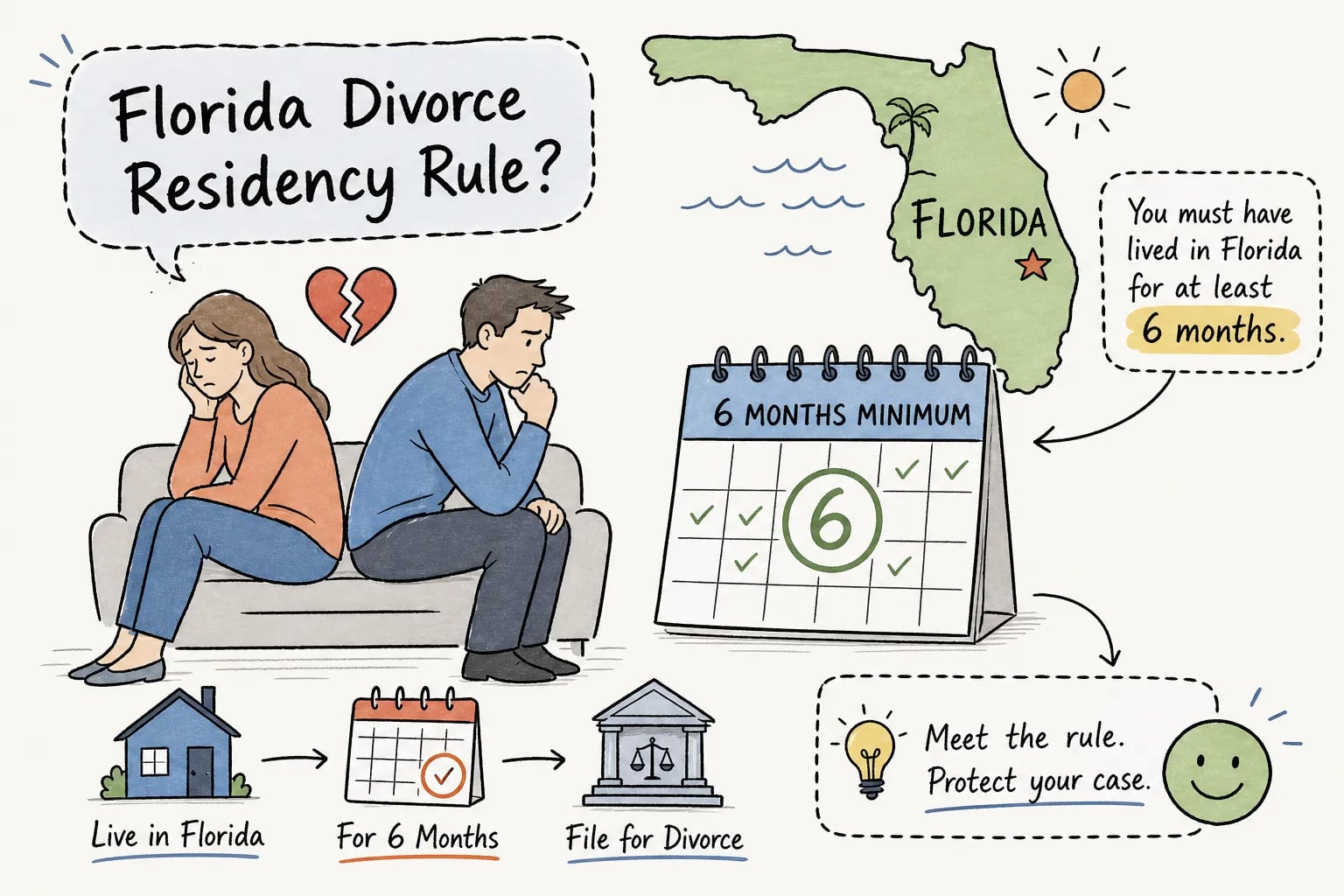
Do You Meet Florida’s 6-Month Divorce Residency Rule?
Picture this: you and your spouse have agreed to end your marriage, you’ve talked through the major terms, and you’re ready to move forward. Then someone asks the question you hadn’t fully thought about, have you actually lived in Florida long enough to file here? If you’re researching Florida uncontested divorce residency requirements, the first thing to confirm is whether you’ve met the six-month threshold. Getting that answer wrong costs real money and real time.
Florida Statutes § 61.021 sets the threshold plainly: “To obtain a dissolution of marriage, one of the parties to the marriage must reside 6 months in the state before the filing of the petition.” File before that six-month mark and the court will dismiss your case, and the filing fees don’t come back with it. That’s why the very first step isn’t filling out paperwork; it’s confirming you actually qualify to file in Florida. Divorce Harmony offers a free initial consultation with Dori Shwirtz to help couples answer exactly this question before spending a cent on documents or court fees.
What Florida’s Six-Month Residency Law Actually Requires
The statute itself is short, but the details matter. The six-month clock runs from the date you established Florida as your home to the date you file the petition, not the date your divorce is finalized. If your court date falls on day 200 but you filed on day 175, you’re fine. If you filed on day 170, you have a problem.
One important clarification: the statute requires residency, not just physical presence. Spending 180 nights in a Florida Airbnb while your real life stays rooted in Georgia does not satisfy the requirement. Florida courts examine domicile, your true, permanent home. Factors courts weigh include where you hold a driver’s license, where you’re registered to vote, where you bank, where you receive mail, and where the center of your daily life actually sits.
The Difference Between Residency and Domicile in Florida Courts
Residency and domicile are often used interchangeably in everyday conversation, but Florida courts treat them as meaningfully different concepts. Residency can be temporary; domicile is the place you’ve chosen as your fixed home with the intent to stay. In a divorce filing, courts look for domicile. A Florida driver’s license, Florida voter registration, and a Florida mailing address all tell a consistent story courts find persuasive, and consistency across those records is what gives your filing a clean evidentiary foundation.
Do Florida Uncontested Divorce Residency Requirements Apply the Same Way to All Cases?
Yes, the six-month rule applies equally to contested and uncontested cases. There are no shortcuts or exemptions based on how cooperative the parties are. What does change in an uncontested filing is the nature of the proof required. Courts handling agreed cases typically accept a driver’s license, voter registration, or a corroborating affidavit without needing a full evidentiary hearing. The requirement itself doesn’t bend; the process for satisfying it simply moves more smoothly when both spouses are aligned.
Which Documents Satisfy Florida Uncontested Divorce Residency Requirements
Bringing the right documents from the start prevents delays and avoids the frustration of a request for additional proof after you’ve already filed. Under Fla. Stat. § 61.021, courts commonly treat certain forms of evidence as primary corroboration, while others serve a supporting role. Knowing which carries the most weight saves time.
The Primary Forms of Evidence Courts Prefer
A Florida driver’s license or state-issued ID card, issued at least six months before your filing date, is generally the strongest single piece of evidence you can provide. A Florida voter registration card carries nearly the same weight. Both reflect official, government-recorded decisions to establish Florida as your home, exactly the intent courts are looking for. When these two documents align on the same Florida address, they create a very clean evidentiary record. Courts commonly treat driver’s licenses, voter registration cards, and state IDs as the primary forms of corroboration under Florida practice guidance.
Supporting Documents That Strengthen Your Case
Secondary evidence doesn’t replace primary documents, but it reinforces them when timing is close or the record needs additional support. Signed lease agreements in your name at a Florida address, utility bills showing consistent Florida service, and bank statements reflecting a Florida address all contribute to the picture. These documents rarely stand alone as proof, but they add meaningful context, particularly if your driver’s license or voter card was issued within a few months of your filing date. Courts and practitioners consistently treat these items as corroborating evidence rather than standalone proof.
When a Third-Party Affidavit Becomes Necessary
Florida Statutes § 61.021 explicitly allows a corroborating witness affidavit as acceptable residency evidence. This option is most useful when you’ve recently moved to Florida, when your official ID hasn’t been updated yet, or when there are gaps in your documentation. The affidavit comes from someone who can personally attest to your Florida residency: a neighbor, a coworker, or a friend who has seen where you live and how you’ve built your life here. Per standard Florida practice, this witness must be an independent third party, not the other spouse.
What Happens When Only One Spouse Lives in Florida
This is one of the most common points of confusion, and the answer is simpler than most people expect. Florida only requires one spouse to satisfy the six-month residency rule. The other spouse can live in Ohio, Texas, another country, or anywhere else entirely. The case can still be filed in Florida as long as the filing spouse meets the requirement and provides the appropriate proof.
How the Out-of-State Spouse Participates
In an uncontested divorce, the non-filing spouse typically signs an Answer and Waiver, a Florida court document confirming that the spouse received the petition, agrees to the terms, and waives the right to a formal hearing. It makes the process fully remote for both parties. In most cooperative, uncontested cases, the out-of-state spouse does not need to appear in a Florida courtroom. This is how the process is designed to function when both spouses are in agreement, though local rules and individual circumstances can occasionally affect requirements.
What This Means for Jurisdiction and the Final Judgment
Once the residency requirement is met by one spouse, Florida courts have full jurisdiction to dissolve the marriage and address the division of marital assets. Under the Full Faith and Credit Clause of the U.S. Constitution, the Florida divorce decree is recognized and enforceable in all fifty states, though enforcement of ancillary matters such as out-of-state property or child support may involve additional considerations. The out-of-state spouse’s location is a logistical consideration, not a legal barrier, as long as the residency box is checked on the Florida side.
How Snowbirds and Military Members Handle Florida’s Residency Question
Two groups consistently run into confusion over this requirement: seasonal residents who split time between Florida and another state, and active-duty military members whose service moves them around. Both situations are manageable, but both require a closer look at how courts define the concept of home.
What Florida Courts Look for Beyond Winter Stays
Owning a Florida condo and spending November through April here every year is a meaningful start, but courts don’t stop at the calendar. For snowbirds, the question is whether Florida functions as the primary home rather than a seasonal stop. Courts examine where you hold your driver’s license, where you’re registered to vote, where your vehicle is registered, where your insurance policies are based, and where you see your doctors. A Florida driver’s license and Florida voter registration together carry significant weight in this analysis. If both of those still point to Michigan or New York, the snowbird argument becomes much harder to make.
Military Service Members and the Residency Question
Active-duty service members stationed in Florida can generally satisfy the six-month rule if they’ve established Florida as their home of record and maintained those ties over the required period. Brief absences due to deployment or temporary duty don’t automatically break residency, provided Florida remains the documented domicile throughout. Because military assignments and orders vary widely in length and location, this is one area where a case-by-case review matters. Schedule a free consultation with Divorce Harmony to get a clear answer before you file.
The Simplest Way to Confirm Your Eligibility Before Filing
The most common and costly mistake couples make is starting the paperwork before confirming they actually qualify. They gather documents, fill out forms, and pay fees, only to discover that the filing is premature and the case gets dismissed. One short conversation can prevent all of that wasted effort and expense.
Why Confirming Residency Eligibility First Saves Time and Money
When a petition is filed before the six-month period is complete, the court dismisses it under Fla. Stat. § 61.021. Filing fees are not refunded, and any documents already prepared need to be revised and refiled, resetting the entire process with no procedural grace period. Confirming eligibility before filing isn’t extra work; it’s the most efficient version of the process.
How Divorce Harmony’s Free Consultation Works
Dori Shwirtz is a licensed Florida attorney, a Florida Supreme Court Certified Mediator, and a divorce coach with more than twenty years of experience guiding couples through exactly this kind of process. At Divorce Harmony, Dori offers a free initial consultation to help couples determine whether they meet the residency requirement, which documents to gather, and whether their case qualifies as uncontested. For couples who are a few weeks away from the six-month mark, she can also advise on the right timing to file so the process moves cleanly from the start. No pressure, no commitment, just a clear, informed answer before the paperwork begins.
Your Next Steps Once Residency Is Confirmed
Once you know you qualify, the path forward is straightforward. The groundwork you’ve done understanding the residency rules translates directly into document preparation, and document preparation translates directly into filing.
Pulling Together Your Residency Proof Package
Gather your primary ID documents first: your Florida driver’s license or state ID, and your Florida voter registration card. Then pull supporting materials, including a current lease agreement, recent utility bills in your name, and bank statements showing your Florida address. If your documentation has any gaps, identify a neighbor, coworker, or friend who can provide a corroborating affidavit. Having all of this organized before your consultation means the conversation moves faster and the filing timeline stays on track.
Starting Your Uncontested Divorce in Florida
Once residency is confirmed, the process through Divorce Harmony moves quickly. Dori handles all document drafting and e-filing, and the full process, from first consultation to finalized divorce, typically completes in about 30 days, depending on county and case specifics. No court appearances are required for qualifying uncontested cases. For couples who agree on the major terms of their separation, this is the most direct path from ready to resolved, and it starts with a single free conversation.
Do You Meet Florida’s Residency Requirement? Here’s How to Know.
Florida’s six-month residency rule is one of the more straightforward thresholds in the divorce filing process, but only if you understand what courts are actually measuring. One spouse needs to meet it; both don’t. Domicile matters more than a simple count of nights. And the documents courts want to see are ones most Florida residents already have on hand.
Whether you’re a longtime Florida resident, a recent transplant, a snowbird sorting out domicile, or a military member navigating home-of-record questions, your eligibility under Florida uncontested divorce residency requirements is knowable before you spend anything on the process. Confirm the six-month mark before you file, gather your primary ID and supporting documents, and understand that an out-of-state spouse doesn’t block a Florida filing.
Divorce Harmony offers a free initial consultation as the fastest, clearest way to confirm whether you’re ready to file, what you need to gather, and how quickly your case can move forward. If you have questions about Florida uncontested divorce residency requirements, that conversation is the right first step, before the paperwork, before the fees, and before any guesswork.
Frequently Asked Questions
How long do I need to live in Florida before I can file for divorce?
Under Florida Statutes § 61.021, at least one spouse must reside in Florida for six months before the petition is filed. File before that six-month mark and the court will dismiss the case, and the filing fees don't come back. The six-month clock runs from the date you established Florida as your home to the date you file the petition, not the date your divorce is finalized.
Does the six-month clock stop at filing, or does it need to cover the whole case?
It only needs to be met as of the filing date. If your court date falls on day 200 but you filed on day 175, you're fine. If you filed on day 170, you have a problem. What happens after filing, including the final hearing, doesn't factor into whether the six-month threshold was met.
What's the difference between residency and domicile in a Florida divorce case?
Residency can be temporary; domicile is the place you've chosen as your fixed, permanent home with the intent to stay. Florida courts look for domicile, not just physical presence. Spending 180 nights in a Florida Airbnb while your real life stays rooted elsewhere doesn't satisfy the requirement. Courts weigh where you hold a driver's license, where you're registered to vote, where you bank, where you receive mail, and where the center of your daily life actually sits.
Do both spouses need to meet the six-month residency requirement?
No. Florida only requires one spouse to satisfy the six-month residency rule. The other spouse can live in another state or another country entirely. The case can still be filed in Florida as long as the filing spouse meets the requirement and provides the appropriate proof.
Does the residency requirement work differently for uncontested cases?
The six-month rule applies equally to contested and uncontested cases; there are no shortcuts or exemptions based on how cooperative the parties are. What changes in an uncontested filing is the nature of the proof required. Courts handling agreed cases typically accept a driver's license, voter registration, or a corroborating affidavit without needing a full evidentiary hearing.
What documents prove Florida residency for a divorce filing?
A Florida driver's license or state-issued ID, issued at least six months before your filing date, is generally the strongest single piece of evidence, with a Florida voter registration card carrying nearly the same weight. Supporting documents, such as a signed lease in your name at a Florida address, utility bills showing consistent Florida service, and bank statements reflecting a Florida address, don't replace primary documents but reinforce them when timing is close or the record needs more support.
When do I need a third-party affidavit to prove residency?
Florida Statutes § 61.021 explicitly allows a corroborating witness affidavit as acceptable residency evidence. It's most useful when you've recently moved to Florida, your official ID hasn't been updated yet, or there are gaps in your documentation. The witness, a neighbor, coworker, or friend who can personally attest to your Florida residency, must be an independent third party, not the other spouse.