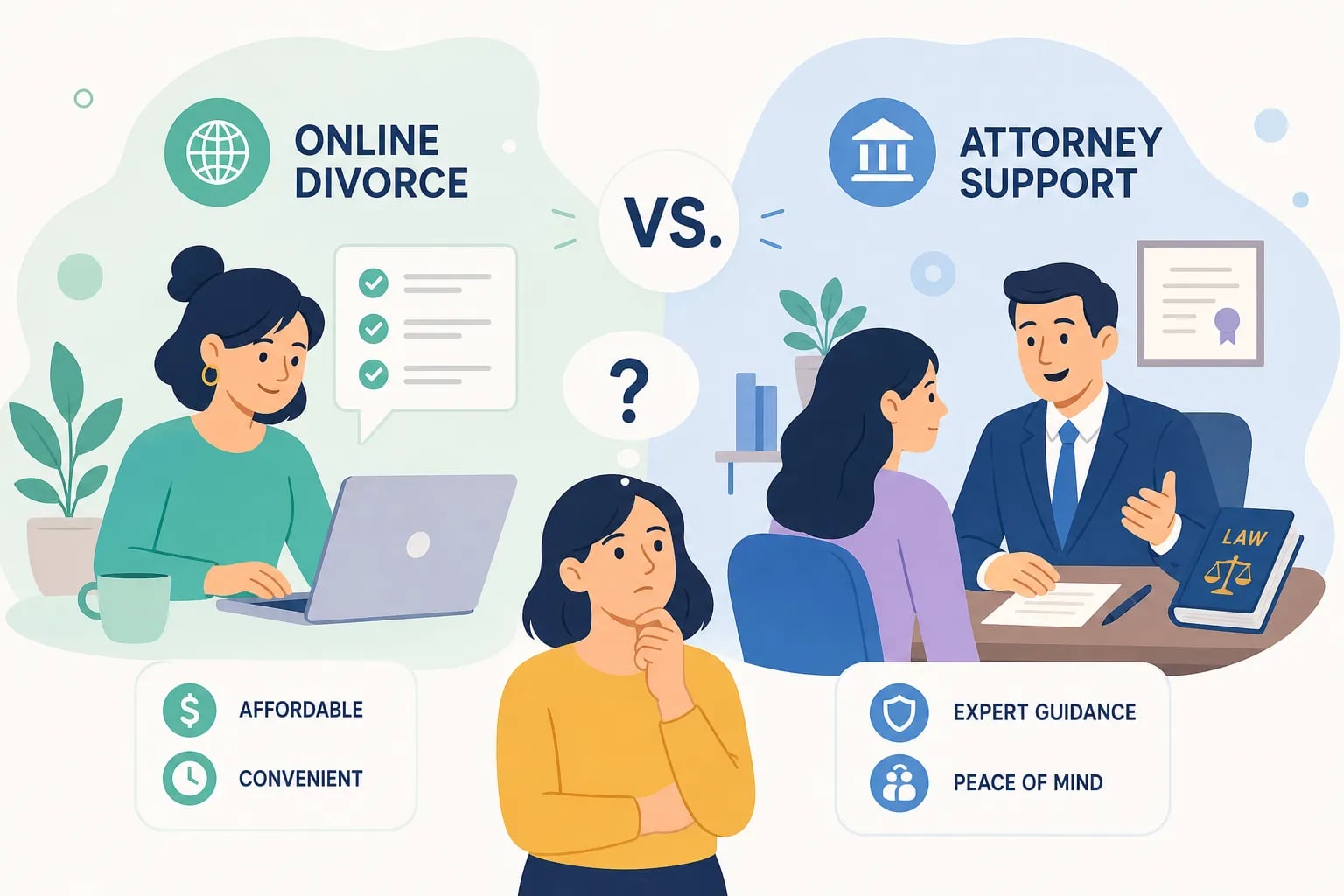
Online Divorce vs. Florida Attorney: Which Is Right for You?
If you’re weighing the pros and cons of online divorce vs. a traditional attorney in Florida, you’re not alone, and the choice is more nuanced than most people expect. Many couples assume they’re stuck picking between a cheap online form service that leaves them guessing and an expensive attorney who charges by the hour. That either/or framing can drive real mistakes, both financial and legal. The truth is that cost, timeline, complexity, and risk interact in ways that make neither option universally better. What actually matters is which one fits your specific situation.
This article breaks down both paths honestly: what each will cost you, how long each takes, when one is clearly the right call, and what can go wrong when people choose the wrong fit. It also introduces a third approach most Florida couples haven’t considered, one that sits squarely between a document mill and a full-service law firm. By the end, you’ll have a clear decision framework for your actual case, not a generic one.
What you’ll actually spend: online divorce vs. Florida attorney
Most couples research divorce options without first looking up real numbers, and that’s where the sticker shock hits. Understanding what each path genuinely costs, including the fees that don’t show up in the headline price, changes the decision significantly.
Online divorce service pricing in Florida
For a fully online uncontested divorce in Florida, the total out-of-pocket cost typically lands between $450 and $1,500. That breaks down as document preparation fees ranging from $159 to $750, plus Florida’s court filing fee of approximately $400 to $410. What that price buys you is document preparation and filing support. What it doesn’t include is legal advice, strategic guidance, representation if something goes sideways, or someone who can catch errors before they become rejections.
Florida attorney fee ranges and hourly billing
A Florida family law attorney handling an uncontested divorce typically charges between $1,500 and $5,000 on a flat-fee basis. Hourly billing runs from $225 to $500 per hour, and even a “simple agreed divorce” can generate $900 to $5,000 or more in billable time depending on how many drafts, calls, and corrections are involved. Once a divorce becomes contested, attorney costs climb well past those ranges, often significantly.
The cost calculation that actually matters
Sticker price is not the same as total cost. Consider this scenario: a $750 online service that produces a rejected filing, a vague settlement agreement, or incomplete financial disclosures can end up costing far more in corrections, refiling fees, or post-divorce litigation than a $2,500 flat-rate professional service would have cost from the start. The real question isn’t which option is cheapest upfront; it’s which option creates the least financial risk for your specific case.
Pros and cons of online divorce vs. a traditional Florida attorney
Before diving into timelines and eligibility, it helps to see the core trade-offs side by side. Here’s a straightforward breakdown of the benefits and drawbacks of each path.
Online divorce in Florida: pros and cons
Pros:
- Lower upfront cost, typically $450 to $1,500 all-in for uncontested cases
- Faster process when paperwork is clean, many cases finalize in 30 to 45 days
- Fully remote, no court appearances required in uncontested cases
- Convenient e-filing through Florida’s court portal
- Works well for simple, fully agreed divorces with limited shared assets
Cons:
- No legal advice, document prep services cannot counsel you on your rights
- High rejection risk if forms are incomplete or incorrectly notarized
- Vague or poorly drafted agreements can create costly post-divorce disputes
- Not designed for cases involving contested custody, business interests, retirement accounts, or domestic violence
- DIY divorce forms in Florida must meet the same standards as attorney-prepared filings, the portal won’t catch substantive errors
Traditional Florida attorney: pros and cons
Pros:
- Full legal advice, advocacy, and representation
- Handles complex cases, custody disputes, QDROs, business valuations, hidden assets
- Reduces risk of rejected filings or agreements that fall apart post-judgment
- Essential in cases involving domestic violence or an uncooperative spouse
Cons:
- Higher cost, flat-fee uncontested divorces run $1,500 to $5,000; hourly billing adds up fast
- Slower process, attorney-assisted uncontested divorces commonly take two to four months
- Hourly surprises: questions, revisions, and phone calls all generate billable time
- May feel impersonal, especially at larger firms handling high volumes
How long each path takes from filing to final judgment
Florida law sets a non-negotiable 20-day waiting period between filing and the entry of a final judgment. No service, attorney, or online platform can shortcut that window. What varies significantly is everything that happens around it.
Typical timelines for online uncontested divorces
For simple, fully agreed cases with clean paperwork, online uncontested divorces in Florida typically finalize in 30 to 45 days. A more realistic range for most filers, when you account for paperwork prep, service on the spouse, and court scheduling, is one to three months. Professional services that handle e-filing on your behalf can move through the paperwork stage quickly, though the final judgment is always subject to Florida’s mandatory 20-day waiting period after filing.
Typical timelines for attorney-assisted divorces
Attorney-assisted uncontested divorces in Florida commonly land in the two to four month range. Depending on the firm’s internal process, court docket availability, and back-and-forth document review, some cases stretch to four to six months. The attorney process tends to be more methodical, which is valuable in complex cases but slower in straightforward ones.
What causes delays in either path
Four factors consistently push timelines out in both online and attorney-led divorces:
- Incomplete or incorrect paperwork that requires correction and refiling
- Delays in serving the spouse or obtaining required signatures
- Court-calendar backlogs for scheduling the final hearing or judicial review
- Additional requirements when minor children are involved, including parenting classes, time-sharing agreements, and extra forms
These delays hit DIY filers hardest because there’s no professional reviewing the packet before it goes to the clerk. A rejected e-filing doesn’t just waste time; it resets parts of the clock and adds stress to an already difficult process.
When online divorce makes sense, and when it doesn’t
Understanding the pros and cons of online divorce vs. a traditional Florida attorney means knowing which cases each path was actually built for. Online divorce is a legitimate, legally binding option in Florida. It’s not a workaround or a loophole. For the right cases, it’s genuinely the most efficient path. The key is knowing whether your case actually qualifies.
Cases where online services work well
The profile for a strong online divorce candidate looks like this: the divorce is uncontested, both spouses agree on all terms, there are no minor children or there’s already a fully documented parenting plan in place, shared assets are limited, the marriage was relatively short, and both parties are cooperative and reachable. Florida’s residency requirement applies regardless of which path you choose: at least one spouse must have been a Florida resident for six months before filing. That’s a statutory requirement, not a formality. E-filing through Florida’s court portal requires exactly the same complete documentation as a paper filing, the submission method changes, but the standards don’t.
Red flags that make attorney involvement necessary
Some situations aren’t just better suited to an attorney, they require one. Domestic violence or safety concerns, disputed child custody, disagreements on parenting time or child support, significant business interests, retirement accounts that require a QDRO, real estate with equity disputes, hidden finances, an uncooperative spouse, or any spousal support disagreement: these aren’t cases where online-only services cut corners. They’re cases those services aren’t designed to handle at all. Using a document prep service in these situations doesn’t save money; it creates liability.
The gray zone: uncontested but complicated
Some cases feel uncontested on the surface but have real complexity underneath. A divorce with minor children where the parenting plan hasn’t been fully worked out is a common example. “We basically agree” is not the same as “we have a court-ready written agreement that satisfies Florida’s parenting plan requirements.” The gap between those two things is where post-divorce conflicts are born. If you’re in that gray zone, professional guidance isn’t optional, it’s protective.
The real risks hiding in DIY divorce agreements
An online-prepared divorce agreement isn’t automatically invalid. Florida courts don’t penalize people for preparing their own forms. But DIY divorce forms in Florida carry specific failure points that often don’t surface until months or years after the divorce is finalized.
How Florida courts reject DIY filings upfront
The most common reasons Florida circuit courts reject uncontested divorce paperwork through the e-file divorce portal include missing or improper signatures, notarization errors, using the wrong form set, incomplete financial disclosure affidavits (Form 12.902(b) or 12.902(c), the standard financial disclosure forms Florida requires based on income level), missing the UCCJEA affidavit in cases with children, and missing residency proof. The clerk doesn’t coach filers through corrections. The filing comes back, the process stalls, and the couple has to restart parts of the process. E-filing doesn’t simplify these requirements; it just moves the rejection from a physical window to a digital notification.
When agreements fall apart after the divorce is finalized
Once a marital settlement agreement is incorporated into a final judgment, it becomes binding, but “binding” doesn’t mean “immune from challenge.” Florida law allows agreements to be set aside for fraud, duress, misrepresentation, overreaching, or terms that are unreasonably one-sided. More commonly, vague language on asset division, alimony, or parenting terms becomes the source of post-divorce litigation and modification filings. The divorce being finalized doesn’t end the legal exposure; it just makes future disputes more expensive to resolve. A well-drafted agreement reviewed by someone who knows Florida family law is one of the most practical protections against that outcome.
The hybrid approach most Florida couples haven’t considered
Weighing the pros and cons of online divorce vs. a traditional Florida attorney can feel like a forced choice, but for most couples, the answer doesn’t fit neatly into either category. That gap is exactly where a hybrid model operates: one that combines the affordability and convenience of virtual divorce services with professional legal oversight.
What makes Divorce Harmony’s model different from both options
Divorce Harmony was built to serve couples who want qualified professional guidance without the cost structure of a traditional law firm. The service is led by Dori Shwirtz, who holds credentials as a licensed Florida attorney, a Florida Supreme Court Certified Mediator, and a divorce coach. That combination changes what clients actually get from the process. Unlike generic document-prep services, Divorce Harmony provides individual attention to each case, handles document drafting promptly after intake, and manages e-filing on the client’s behalf. Unlike traditional law firms, the service operates fully online, requires no court appearance for qualifying uncontested cases, and uses flat-rate pricing so you know what you’ll pay before you start. There are no hourly billing surprises and no reason to avoid asking questions because the clock is running.
How the process works in practice
The process starts with a free initial consultation to assess eligibility and answer questions. From there, Divorce Harmony handles document drafting, online notarization (available directly through the service, with no separate appointment needed), e-filing, and certified mediation for cases that involve minor children or require professional facilitation to reach agreement. Specialized case types include divorces without minor children, with minor children, and missing-spouse cases. The typical timeline for finalization is approximately 30 days from filing, subject to Florida’s mandatory 20-day waiting period and court scheduling. Prenuptial and postnuptial agreements are also available for couples who want professionally drafted, legally sound marital agreements without paying traditional law firm rates.
Making the call with confidence: online divorce vs. Florida attorney
Here’s a practical framework for deciding between the pros and cons of online divorce vs. a traditional Florida attorney: if your case is simple, fully agreed, and asset-light, virtual divorce services are a legitimate and cost-effective choice. If there’s conflict, children without a complete parenting plan, complex finances, or any safety concern, professional involvement isn’t optional, and trying to save money by skipping it will cost more in the long run.
For most Florida couples who want speed, affordability, and genuine legal expertise without a courtroom or an hourly billing statement, Divorce Harmony offers a model that doesn’t ask you to choose between professional quality and a price that makes sense. The free initial consultation is a smart first step regardless of which direction you’re leaning, because the most reliable way to know which path fits is to have someone qualified review your actual situation. Reach out to schedule yours and get a clear answer about where your case stands.
Frequently Asked Questions
How much does an online divorce cost in Florida?
A fully online uncontested divorce in Florida typically costs between $450 and $1,500 total. That includes document preparation fees of $159 to $750 plus Florida's court filing fee of about $400 to $410. That price covers document preparation and filing support -- it does not include legal advice, strategic guidance, or representation.
How much does a Florida divorce attorney cost?
A Florida family law attorney handling an uncontested divorce typically charges $1,500 to $5,000 on a flat-fee basis, or $225 to $500 per hour. Even a simple agreed divorce can generate $900 to $5,000 or more in billable time. Once a divorce becomes contested, costs climb well past those ranges.
How long does an online divorce take in Florida?
Simple, fully agreed cases with clean paperwork typically finalize in 30 to 45 days. A more realistic range for most filers, accounting for paperwork prep, service on the spouse, and court scheduling, is one to three months. Every case is still subject to Florida's mandatory 20-day waiting period after filing.
How long does an attorney-assisted divorce take in Florida?
Attorney-assisted uncontested divorces in Florida commonly take two to four months, and some cases stretch to four to six months depending on the firm's process, court docket availability, and document review.
Is online divorce legal in Florida?
Yes. Online divorce is a legitimate, legally binding option in Florida, not a workaround or a loophole. At least one spouse must have been a Florida resident for six months before filing, and e-filed paperwork must meet the same documentation standards as a paper filing.
When should I use an attorney instead of an online divorce service?
Attorney involvement is necessary for cases involving domestic violence or safety concerns, disputed child custody, significant business interests, retirement accounts requiring a QDRO, real estate equity disputes, hidden finances, an uncooperative spouse, or any spousal support disagreement. These are not cases where online-only services cut corners -- they are cases those services aren't designed to handle.
Why do Florida courts reject DIY divorce filings?
The most common rejection reasons are missing or improper signatures, notarization errors, using the wrong form set, incomplete financial disclosure affidavits, a missing UCCJEA affidavit in cases with children, and missing residency proof. The clerk does not coach filers through corrections -- the filing simply comes back and the process stalls.
Can a Florida divorce agreement be challenged after it's finalized?
Yes. Florida law allows a marital settlement agreement to be set aside for fraud, duress, misrepresentation, overreaching, or terms that are unreasonably one-sided. More commonly, vague language on asset division, alimony, or parenting terms becomes the source of post-divorce litigation and modification filings.
What is Divorce Harmony's hybrid approach to divorce?
Divorce Harmony combines the affordability and convenience of online divorce services with professional oversight from Dori Shwirtz, a licensed Florida attorney, Florida Supreme Court Certified Mediator, and divorce coach. The service offers flat-rate pricing, online notarization, e-filing, and certified mediation, with no court appearance required for qualifying uncontested cases and a typical timeline of about 30 days from filing.