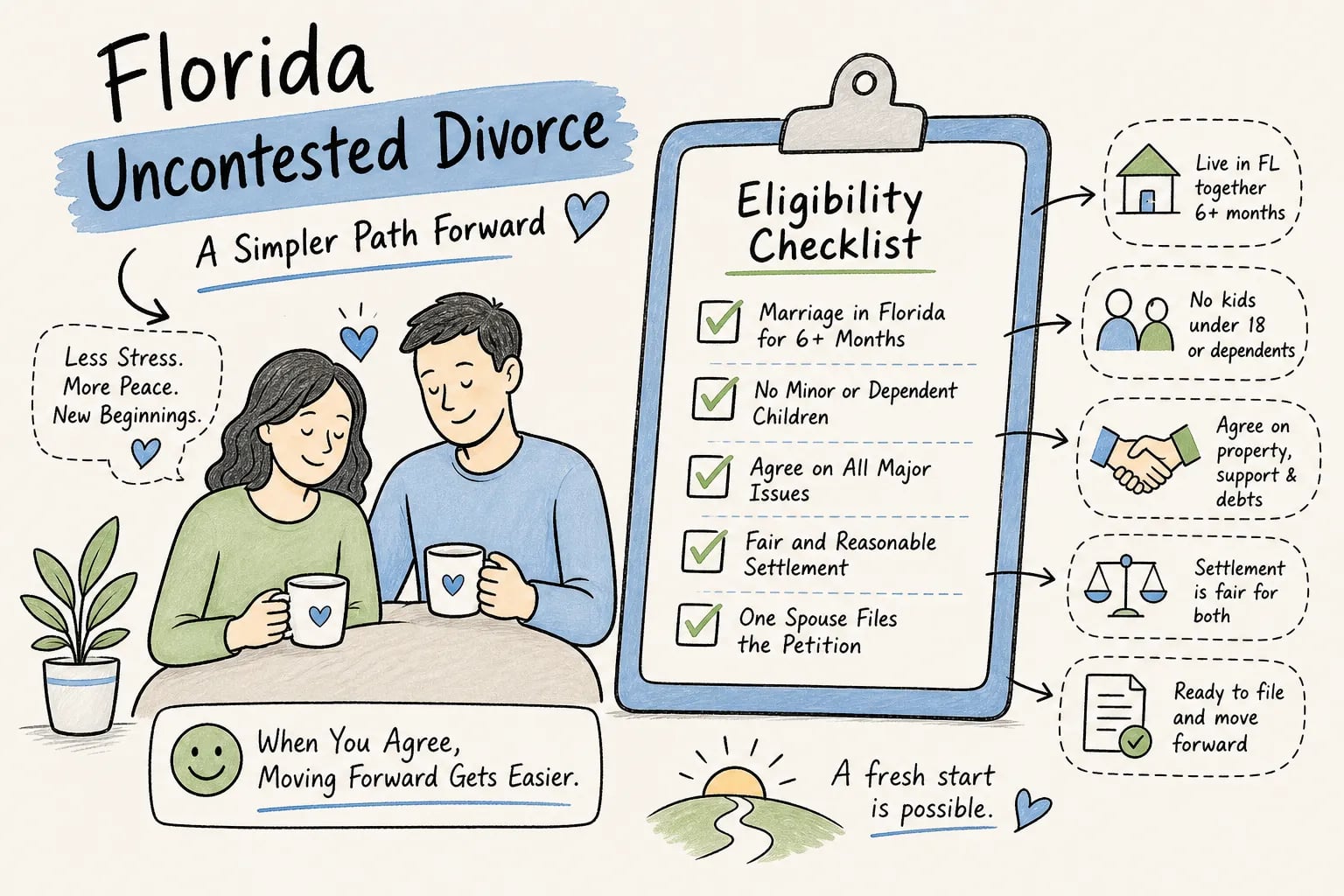
Florida Uncontested Divorce: The Full Eligibility Checklist
Most people assume divorce is automatically complicated, expensive, and involves months of courtroom appearances. That assumption stops a lot of couples from exploring a path that would have worked just fine for them. If you need to confirm uncontested divorce eligibility criteria in Florida, this checklist walks through every factor that matters: residency, agreement requirements, children, alimony, property, and the right procedural track. An uncontested divorce in Florida can be far simpler than the stories you’ve heard, but only if you actually qualify. The question is knowing whether you do.
Use this as a self-assessment before you file anything or pay anyone. That said, it’s not a substitute for a legal review. Dori Shwirtz, a licensed Florida attorney and Florida Supreme Court Certified Mediator at Divorce Harmony, offers a free initial consultation specifically to confirm eligibility before you commit to a single step. Couples who come in uncertain walk out knowing exactly where they stand.
Work through each section. By the end, you’ll have a clear sense of whether uncontested dissolution is your path and which version of it fits your situation.
The Difference Between Simplified Dissolution and Regular Uncontested Divorce
Two separate tracks, two sets of rules
Florida law offers two paths for couples who agree on divorce. Simplified dissolution of marriage is the faster, lighter-weight option, with stricter eligibility requirements. Regular uncontested dissolution handles more complex situations, minor children, alimony, more significant property, while still keeping both spouses in agreement throughout. Both paths avoid contested litigation, but the criteria differ significantly, and picking the wrong track has real consequences.
Most readers will need to identify which track fits before they can move forward. The checklist below makes that clear, but it helps to understand the distinction first so none of the criteria feel arbitrary.
Why the distinction matters before you file
Filing under simplified dissolution when you don’t qualify gets your case rejected. Filing a regular uncontested petition when simplified would have worked means unnecessary steps and added cost, typically extra forms, potential additional hearings, and higher professional fees. Neither outcome is catastrophic, but both waste time. The practical move is to get this right before you file, not after.
Uncontested Divorce Eligibility Criteria Florida: Residency and Timeline
The Florida residency requirement: the first box to check
At least one spouse must have lived in Florida continuously for six months immediately before filing. The other spouse can live anywhere: another state, another country. Only one of you has to meet this requirement. Florida courts will ask for proof, a Florida driver’s license, state ID, voter registration card, or a corroborating affidavit from someone who can confirm your residency. Gather that documentation early, because the clerk will want to see it.
The six months must be continuous and immediately before filing. Traveling out of state during that period generally doesn’t reset the clock, but your primary residence during those months must have been Florida. Because residency is fact-specific, extended absences could create disputes; if your situation is borderline, confirm it with an attorney before filing.
What happens if neither spouse qualifies yet
If neither of you has reached the six-month mark, filing must wait. There’s no workaround for this one. It’s a jurisdictional requirement under Florida Statutes § 61.021, which means a court can’t grant the divorce until it’s satisfied. The straightforward move is to identify when one of you will hit the threshold and plan your filing date accordingly.
Full Eligibility Checklist: Florida Uncontested Divorce Criteria
Requirements for simplified dissolution of marriage
Simplified dissolution is only available when every condition on this list is true at the same time. If even one doesn’t apply, you move to regular uncontested dissolution instead.
- No minor or dependent children together (biological, adopted, or born during the marriage)
- The wife is not pregnant
- Both spouses agree the marriage is irretrievably broken
- Both spouses have fully agreed on how all marital property and debts are divided
- Neither spouse is seeking alimony
- At least one spouse meets the six-month Florida residency requirement
- Both spouses consent to use the simplified process and are willing to appear to sign as required
All seven conditions must be true. This is not a “most of the above” situation. Florida courts apply these requirements strictly, and the simplified petition will be rejected if any condition is unmet at the time of filing. It’s also worth noting that Florida is a no-fault divorce state, meaning neither spouse needs to prove wrongdoing, the only ground required is that the marriage is irretrievably broken, which applies to both simplified and regular uncontested filings.
What disqualifies simplified dissolution but still allows regular uncontested
Failing a simplified dissolution requirement doesn’t mean your divorce has to become contested. If you and your spouse still agree on all major issues, regular uncontested dissolution is a viable path. The key is full agreement, not a specific procedural track.
Minor children require a parenting plan and a child support worksheet, but those can be agreed upon between spouses. One spouse seeking alimony is allowed under regular uncontested dissolution, as long as it’s agreed to and documented in writing. Unresolved debts or property must be settled before filing either way. Both paths share the same essential requirement: mutual agreement on every significant issue. As long as you’re both aligned, one of these two tracks will work for you.
Forms You’ll Need and Where to Get Official Copies
Core forms for both dissolution paths
Florida uses Supreme Court-approved family law forms, and the official source for all of them is the Florida Courts self-help center. County clerk offices also provide access, and some counties offer TurboCourt for completing forms online. For simplified dissolution, the primary form is Form 12.901(a). For regular uncontested dissolution without minor children, you’ll file Form 12.901(b)(1) or (b)(2), along with a marital settlement agreement such as Form 12.902(f)(1).
Filling these out incorrectly is one of the most common reasons cases get delayed or rejected. The forms have specific formatting requirements, and missing a field or misstating asset values can send a filing back to the beginning. If that sounds tedious, it is, and it’s also entirely avoidable with the right support.
Additional forms when children are involved
Regular uncontested divorces with minor children require several more documents filed alongside the petition. You’ll need a parenting plan (Form 12.995(a)), a UCCJEA affidavit (Form 12.902(d)), a child support guidelines worksheet (Form 12.902(e)), and a family law financial affidavit (Form 12.902(b) or (c) depending on income).
One frequently overlooked item is the Notice of Social Security Number form (12.902(j)), available through the Florida Courts forms library, which is mandatory and commonly overlooked by self-filers. Divorce Harmony’s document preparation and e-filing service means clients never have to locate, download, or fill out a single form themselves. For couples with children, that removes most of the friction from the process.
Timeline, Court Fees, and What to Expect After Filing
The 20-day waiting period and realistic timelines
Florida law requires a 20-day minimum waiting period after filing and service before a final judgment can be entered (Florida Statutes § 61.19). That’s the statutory floor, not the average. In practice, most streamlined uncontested cases finalize in 30 to 45 days when all documents are complete and filed correctly from the start. Some counties allow finalization on submitted paperwork alone, with no hearing required. Others schedule a brief final hearing, typically 10 to 15 minutes, where one spouse answers routine questions before the judge.
Divorce Harmony’s document preparation and filing service is designed to move cases through as efficiently as the statutory timeline allows. The fastest outcomes happen when documentation is clean, complete, and filed correctly the first time, which is why getting forms right from the start matters so much.
Filing fees and how to reduce them
The standard filing fee for a petition for dissolution of marriage in Florida runs approximately $408 to $410, with minor variations by county. Miami-Dade, Broward, and Palm Beach currently sit at around $409. If a summons is needed, expect an additional $10, plus $40 to $75 for service of process. Certified copies carry a separate per-page fee, typically around $2 per page.
Florida offers civil indigency fee waivers for qualifying low-income filers. The application is filed with the clerk at the time of petition. If cost is a barrier, it’s worth asking the clerk’s office about the waiver process before assuming you can’t afford to file.
How Divorce Harmony Helps Once You Confirm You Qualify
Free eligibility review with a licensed attorney
Dori Shwirtz is a licensed Florida attorney, not a document service or form generator. The free initial consultation at Divorce Harmony gives you an attorney’s assessment of your eligibility, something a checklist, however thorough, simply can’t provide. Couples who come in unsure whether they fall under simplified or regular uncontested dissolution get a clear answer at no cost, along with a specific explanation of which path applies and what the next steps look like.
That first call is also where questions about children, alimony, shared property, and unresolved debts get answered honestly. If something in your situation is unusual or could affect your Florida uncontested divorce eligibility criteria, Dori flags it before you file, not after.
One service from start to signed final judgment
Once you’re confirmed eligible, Divorce Harmony handles the full process: drafting all required documents, e-filing, and online notarization, all remotely. Most uncontested cases require no courthouse visit, though some counties or case types may still require a brief hearing depending on local rules. For couples with children, mediation is available to finalize parenting plans cooperatively, without either spouse sitting across a courtroom from the other. The entire process is designed for working adults who can’t take days off for hearings or spend months managing paperwork.
If you’ve worked through this checklist and think you qualify, the next step is simple. Schedule a free consultation with Divorce Harmony and confirm your eligibility with a licensed attorney before you file anything. That one conversation can clarify your path and help you avoid weeks of unnecessary back-and-forth.
Eligibility Isn’t Always Obvious at First Glance
The core variables in any assessment of uncontested divorce eligibility criteria in Florida are residency, mutual agreement, children, alimony, and property division. Some situations are clear-cut. Others have wrinkles: a spouse who recently moved out of state, a debt that hasn’t been assigned yet, a question about whether alimony applies. Those details matter, and they’re exactly the kind of thing a licensed attorney identifies in a 20-minute consultation that a self-assessment can miss.
Getting eligibility confirmed before filing saves time and money. It also saves the frustration of having a case rejected and starting over. Divorce Harmony exists precisely for this: to take the uncertainty out of the process and give you a clear answer before you commit to anything.
Uncontested divorce in Florida doesn’t have to mean months of paperwork and courtroom appearances. For most couples who agree on the basics, the process can be straightforward. If you believe you meet the uncontested divorce eligibility criteria Florida courts require, confirm it with Divorce Harmony before you file, and move forward with confidence.
Frequently Asked Questions
What is the residency requirement for an uncontested divorce in Florida? At least one spouse must have lived in Florida continuously for the six months immediately before filing. Proof can include a Florida driver’s license, state ID, voter registration card, or a corroborating affidavit. This is a jurisdictional requirement under Florida Statutes § 61.021, meaning a court cannot grant the divorce until it’s satisfied.
What’s the difference between simplified dissolution and regular uncontested divorce? Simplified dissolution is the faster, lighter-weight option but has stricter eligibility rules: no minor or dependent children, the wife isn’t pregnant, neither spouse is seeking alimony, and both spouses fully agree on how property and debts are divided. Regular uncontested dissolution allows for minor children, alimony, and more complex property situations, as long as both spouses still agree on every major issue.
Can you get a simplified divorce in Florida if you have children? No. Simplified dissolution requires no minor or dependent children together, whether biological, adopted, or born during the marriage. Couples with children can still pursue a regular uncontested divorce if they agree on a parenting plan and child support arrangements.
How much does it cost to file for divorce in Florida? The standard filing fee runs approximately $408 to $410, with small variations by county (Miami-Dade, Broward, and Palm Beach are around $409). A summons adds about $10, service of process runs $40 to $75, and certified copies cost roughly $2 per page. Florida offers civil indigency fee waivers for qualifying low-income filers.
How long does an uncontested divorce take in Florida? Florida law sets a 20-day minimum waiting period after filing and service before a final judgment can be entered (Florida Statutes § 61.19). In practice, most streamlined uncontested cases finalize in 30 to 45 days when the paperwork is complete and correct from the start. Some counties finalize on submitted paperwork alone; others schedule a brief 10- to 15-minute final hearing.
What forms do I need for an uncontested divorce in Florida? For simplified dissolution, the primary form is 12.901(a). For regular uncontested dissolution without minor children, you’ll file Form 12.901(b)(1) or (b)(2) along with a marital settlement agreement (Form 12.902(f)(1)). With minor children, you’ll also need a parenting plan (12.995(a)), a UCCJEA affidavit (12.902(d)), a child support guidelines worksheet (12.902(e)), a family law financial affidavit (12.902(b) or (c)), and the often-overlooked Notice of Social Security Number form (12.902(j)).
Do I need a lawyer for an uncontested divorce in Florida? It’s not legally required, but incorrectly completed forms are one of the most common reasons cases get delayed or rejected. A free eligibility consultation with a licensed attorney can confirm which track applies to your situation and flag any wrinkles, such as residency questions or unresolved debts, before you file rather than after.