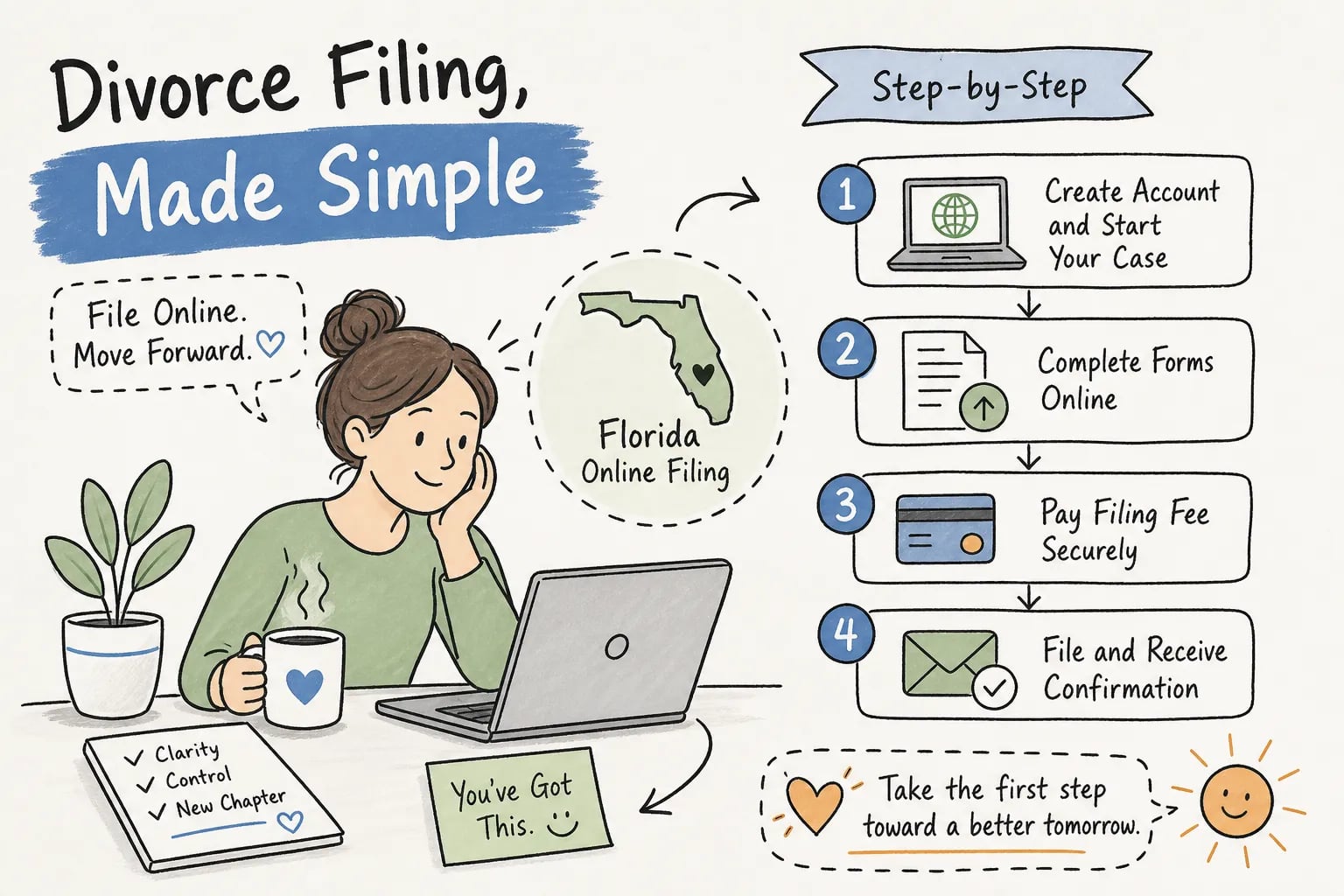
File for Divorce Online in Florida: Step-by-Step 2026 Guide
Most Floridians assume that getting divorced means hiring an attorney, sitting in a waiting room, and eventually walking into a courthouse. That assumption is wrong, and it costs people time and money they don’t need to spend. Florida actually allows self-represented spouses to file for divorce online, completing their entire dissolution of marriage electronically, without ever setting foot in a clerk’s office. But “allowed” and “simple” are two very different things.
This guide explains how to file for divorce online in Florida and what to expect at every stage. Some couples work with a service like Divorce Harmony, where a licensed attorney handles the paperwork, e-filing, and notarization on their behalf. Others want to understand every step before deciding which route to take. This guide is for both groups. By the end, you’ll know whether you qualify, which forms you need, exactly how to submit through MyFLCourtAccess, what it costs, and what happens after you click submit.
Do you qualify to file for divorce online in Florida?
Before you touch a single form, you need to know whether Florida can even hear your case. Skipping this step is the most common way DIY filers waste hours of preparation.
The 6-month Florida residency rule
At least one spouse must have lived in Florida continuously for the six months immediately before filing. The marriage doesn’t have to have happened in Florida, and the other spouse can live in another state entirely. You can prove residency with a Florida driver’s license, a voter registration record, or a sworn affidavit from someone who can confirm your Florida residence. Military servicemembers stationed in Florida may also qualify under a separate exception even if their legal domicile is elsewhere.
Simplified dissolution vs. regular uncontested divorce
Florida offers two paths that work for online filing. The simplified dissolution is the faster option, but it comes with strict conditions: no minor or dependent children, no pregnancy, complete agreement on all property and debts, and neither spouse can seek alimony. Both spouses must also attend a final hearing together. The regular uncontested divorce covers more situations, including cases with children, as long as both spouses agree on every term. Florida is a no-fault state, so the only ground you need is that the marriage is “irretrievably broken.” No separation period is required.
Cases that can’t use the simplified online process
If one spouse won’t cooperate, there’s a disputed asset, or one party wants alimony the other refuses to pay, the case is contested. A contested case doesn’t become uncontested just because you file online. The following situations disqualify you from the simplified procedure: disputed property or debts, a missing spouse who won’t sign, pregnancy, a spouse seeking alimony, or any unresolved issue related to children. You can still pursue a regular uncontested divorce in many of these situations, but you need all terms resolved before filing.
Forms to gather before you file for divorce online in Florida
Florida family law forms are free to download from the official Florida Courts Family Law Forms page. The problem isn’t finding them; it’s knowing which ones apply to your situation.
Choosing the right Form 12.901 petition
The petition is the document that opens your case, and the correct version depends entirely on your circumstances. Using the wrong form version is one of the most common reasons clerks reject a filing. Here’s how the versions break down:
- Form 12.901(a), for simplified dissolution only
- Form 12.901(b)(1), for cases with minor or dependent children
- Form 12.901(b)(2), covers cases with marital property or debts but no children
- Form 12.901(b)(3), applies when there are no children, no marital property, and neither spouse seeks alimony
Download the applicable form and its instructions directly from the Florida Courts site, not from a third-party summary page.
Financial affidavits and marital settlement documents
Nearly every dissolution case requires a sworn financial affidavit. Form 12.902(b) is the short version, used when your individual gross annual income is under $50,000. Form 12.902(c) is the long form for income at $50,000 or above. If you and your spouse have reached an agreement on property and debts, you’ll also need the Marital Settlement Agreement from the 12.902(f) series. These documents aren’t optional extras; they’re required components of a valid filing.
Additional forms when children are involved
Cases with minor children require a Parenting Plan (Form 12.995 series) and a Child Support Guidelines Worksheet (Form 12.902(e)). You’ll also need summons forms 12.910(a) and 12.910(b) for serving the other spouse. Beyond the state-required forms, many Florida circuits require a civil cover sheet, a parties-information form, or a county-specific filing checklist. Always check your county clerk’s website before assuming the state forms alone are sufficient. Local requirements vary more than most people expect.
How to e-file your divorce through MyFLCourtAccess
The official Florida Courts E-Filing Portal is where self-represented litigants submit their divorce documents electronically. Here’s exactly how the process works.
Setting up your account and preparing your documents
Go to MyFLCourtAccess and select the E-Filing Portal. Click “Register” and choose “Self-Represented Litigant” as your filer role. You’ll enter your name, email, contact details, username, and password (the portal currently requires 6 to 16 characters with at least one number). After submitting the registration form, open the activation email and click the link. Account registration is free. Before you upload anything, make sure every document is in PDF format, properly signed and notarized where required, not password-protected, and within the 50 MB aggregate limit per submission. If any filing contains Social Security numbers or other confidential information, you must submit a separate Notice of Confidential Information form under Florida Rule 2.420.
Uploading documents, paying fees, and submitting
Once logged in, select Trial Court, choose your county, pick the Family division, and start a new dissolution case. Enter the petitioner and respondent information exactly as it appears on your legal documents, even minor name discrepancies can trigger a rejection. Use the “Add Document” button for each separate form rather than combining everything into one file. After adding all documents, review the submission screen carefully before proceeding to payment. Pay the filing fee, then submit and save your reference number. You’ll receive two separate emails: one confirming the portal received your submission, and a second from the clerk confirming acceptance or notifying you of a rejection. Rejection is common. When it happens, read the clerk’s stated reason, correct the issue, and resubmit promptly.
What “e-filed” actually means (and what it doesn’t)
Submitting documents through the portal is not the same as your case being officially filed. Filing becomes effective only after the clerk accepts your submission. Beyond that, e-filing does not replace formal service of process on the other spouse. That step happens after acceptance, and it’s where many self-represented filers run into serious problems.
Florida divorce filing fees: what to actually expect
The standard dissolution filing fee across most Florida counties is approximately $408 to $409, with a $10 summons fee on top, bringing the typical initial total to around $418 to $419. Miami-Dade, Broward, Palm Beach, and Hillsborough counties each post a $409 dissolution fee plus $10 for summons issuance, for a starting total of $419. Lee County lists $408 plus $10 per summons, for $418 on one summons. Always verify the current amount on your specific county clerk’s website before submitting, as clerks update their fee schedules and local administrative charges can change the total.
The official Florida Courts E-Filing Portal does not charge a separate transmission fee, though some counties add a small ePortal charge, Polk County, for example, lists a $5 ePortal fee. TurboCourt is a different story: it’s a private third-party service, not the official portal. It charges its own form-preparation fee (around $10.40 in Lee County) and a separate e-filing transmission fee (around $10), plus approximately a 4% credit card convenience fee on top of the court filing amount. Using the official Florida Courts portal avoids those private fees, but you’ll need to prepare all forms yourself.
Service of process through the county sheriff or a certified process server runs $40 to $75 or more and is a separate expense regardless of which portal you use.
What happens after you submit your e-filing
The steps between filing and a final judgment catch many DIY filers off guard. A clerk rejection, a missed service deadline, or a county-specific hearing requirement can push a case that should have closed in weeks into a months-long wait. Knowing what’s coming helps you avoid those delays.
Serving your spouse after the clerk accepts your filing
Once the clerk accepts your filing and issues the summons, you must arrange formal service of process on the respondent. You cannot serve the papers yourself. Service goes through the county sheriff where the respondent can be found or through a certified Florida process server. Provide the server with the summons, the stamped petition, and any documents required by the clerk, along with accurate location details for the respondent. The server then files a return of service with the clerk confirming completion. If the respondent is willing to cooperate, they can sign a court-approved waiver or acceptance of service form, but simply emailing the petition to your spouse does not count as valid service under Florida law.
Timelines and what comes before the final judgment
After service, the respondent has a deadline to file an answer that depends on the method of service used. Florida law imposes a minimum 20-day waiting period after the petition is filed before a final judgment can be entered. For cases involving children, both parents must complete a mandatory parenting course before the case closes. Financial disclosure deadlines and potential mediation requirements also factor into the timeline.
For a clean uncontested case, finalization in approximately 30 days is realistic under normal conditions, though planning for 6 to 12 weeks is more accurate for most situations. Some counties allow the final hearing to be conducted remotely or waived entirely; others still require an in-person appearance. Local rules control this, so check with your circuit’s family-law division early.
When doing it yourself costs more than it saves
The DIY path works well for some couples. For others, the risks quietly outpace the savings, often before they realize it.
Where self-filers most commonly go wrong
The most frequent errors are specific and avoidable, but they still happen constantly. Filing the wrong 12.901 form version, submitting documents that weren’t properly notarized, filing in the wrong county, missing a local circuit’s cover sheet requirement, and misunderstanding the post-filing service process are all common. Financial affidavit errors can have longer-term consequences: a settlement challenged later because the financial disclosure was incomplete creates far more expense than the original filing fee. These aren’t rare edge cases. They’re the primary reasons uncontested divorces drag past 30 days or get dismissed entirely.
How Divorce Harmony handles the entire process on your behalf
Divorce Harmony, led by Dori Shwirtz, a licensed Florida attorney and Florida Supreme Court Certified Mediator, addresses every friction point described in this article. The service drafts all required documents for your specific situation, handles notarization through an online notary service, and e-files with the appropriate court within 48 hours of payment. Cases with or without minor children are handled, and even missing-spouse situations are covered. No courthouse visit is required at any point. A free initial consultation is available to confirm eligibility and walk through what your case involves. For couples who’ve read this guide and realized the process is more involved than expected, Divorce Harmony provides a fully supervised alternative with attorney oversight at every step.
The bottom line
Knowing how to file for divorce online in Florida puts you ahead of most people who start this process. The path is genuinely accessible, but it demands attention to detail at every step. Verify residency eligibility first. Select the correct 12.901 form for your situation. Prepare and notarize all documents before logging into MyFLCourtAccess. Submit through the portal, save your reference number, and arrange formal service after the clerk accepts your filing. Track the timeline and check your county’s local rules for the final hearing.
For couples who want a licensed attorney overseeing the paperwork, handling e-filing, and guiding them through the process without a single courthouse visit, Divorce Harmony offers a fully online, flat-rate service that typically wraps up in about 30 days. Both paths work. Knowing exactly what’s involved is how you choose the right one for your situation.
Divorce Harmony · Frequently Asked Questions
How to File for Divorce Online in Florida: FAQ
Florida lets couples file for divorce online from start to finish, without ever setting foot in a courthouse. But the process has more moving parts than most people expect.
Below are straight answers to the most common questions: who qualifies, which forms you need, how e-filing works, what it costs, and what happens after you submit.
Eligibility: Can You File Online?
Can I really file for divorce online in Florida?
Yes. Florida allows self-represented spouses to complete their entire dissolution of marriage electronically through the official Florida Courts E-Filing Portal (MyFLCourtAccess), without ever visiting a clerk's office.
But "allowed" and "simple" are two very different things. Every form, signature, and deadline still has to be right for your case to move forward.
What is Florida's residency requirement for divorce?
At least one spouse must have lived in Florida continuously for the six months immediately before filing. The marriage doesn't have to have happened in Florida, and the other spouse can live in another state.
You can prove residency with a Florida driver's license, a voter registration record, or a sworn affidavit from someone who can confirm your Florida residence. Military servicemembers stationed in Florida may also qualify under a separate exception.
What's the difference between a simplified dissolution and a regular uncontested divorce?
A simplified dissolution is the faster option, but it has strict conditions: no minor or dependent children, no pregnancy, complete agreement on all property and debts, and neither spouse can seek alimony. Both spouses must also attend a final hearing together.
A regular uncontested divorce covers more situations, including cases with children, as long as both spouses agree on every term.
Florida is a no-fault state, so the only ground you need is that the marriage is "irretrievably broken." No separation period is required.
What disqualifies a case from the simplified online process?
- Disputed property or debts
- A missing spouse or a spouse who won't sign
- Pregnancy
- A spouse seeking alimony
- Any unresolved issue related to children
Many of these cases can still proceed as a regular uncontested divorce, but only once every term is resolved before filing. Filing online doesn't turn a contested case into an uncontested one.
Forms You'll Need
Which Florida divorce petition form do I need?
It depends entirely on your circumstances, and using the wrong version is one of the most common reasons clerks reject a filing:
- Form 12.901(a) -- simplified dissolution only
- Form 12.901(b)(1) -- cases with minor or dependent children
- Form 12.901(b)(2) -- marital property or debts, but no children
- Form 12.901(b)(3) -- no children, no marital property, and no alimony requested
Download the form and its instructions directly from the official Florida Courts Family Law Forms page, not from a third-party summary site.
Do I need a financial affidavit?
Nearly every dissolution case requires one. Use Form 12.902(b) (short form) if your individual gross annual income is under $50,000, or Form 12.902(c) (long form) if it's $50,000 or more.
If you and your spouse have agreed on property and debts, you'll also need a Marital Settlement Agreement from the 12.902(f) series.
What additional forms are required if we have children?
Cases with minor children require a Parenting Plan (Form 12.995 series) and a Child Support Guidelines Worksheet (Form 12.902(e)). You'll also need summons forms 12.910(a) and 12.910(b) to serve the other spouse.
Does my county have its own filing requirements?
Often, yes. Many Florida circuits require a civil cover sheet, a parties-information form, or a county-specific filing checklist on top of the state forms. Always check your county clerk's website before assuming the state forms alone are enough.
E-Filing Through MyFLCourtAccess
How do I set up a MyFLCourtAccess account?
Go to MyFLCourtAccess, select the E-Filing Portal, click "Register," and choose "Self-Represented Litigant" as your filer role. Enter your name, email, contact details, username, and a password (6 to 16 characters with at least one number), then click the link in the activation email. Registration is free.
How should I prepare my documents before uploading?
- Save every document as a PDF
- Sign and notarize where required
- Don't password-protect any file
- Stay within the 50 MB total limit per submission
- Upload each form separately using "Add Document" rather than combining them
- Enter names exactly as they appear on your legal documents
If any filing contains Social Security numbers or other confidential information, you must also submit a Notice of Confidential Information under Florida Rule 2.420.
What happens after I click submit?
You'll receive two emails: one confirming the portal received your submission, and a second from the clerk confirming acceptance or explaining a rejection. Rejections are common. If it happens, read the clerk's reason, fix the issue, and resubmit promptly.
Your case is officially filed only once the clerk accepts it, and e-filing does not replace formal service on your spouse.
Costs and Fees
How much does it cost to file for divorce in Florida?
The standard dissolution filing fee in most Florida counties is about $408 to $409, plus a $10 summons fee, for a typical starting total of $418 to $419.
Miami-Dade, Broward, Palm Beach, and Hillsborough counties each list $409 plus $10 for summons ($419 total). Lee County lists $408 plus $10 per summons. Always confirm the current amount on your county clerk's website.
Are there extra fees for filing online?
The official Florida Courts E-Filing Portal doesn't charge a separate transmission fee, though some counties add a small ePortal charge (Polk County, for example, lists $5).
TurboCourt is a private third-party service, not the official portal. It charges its own form-preparation fee (around $10.40 in Lee County), an e-filing fee (around $10), and roughly a 4% credit card convenience fee on top of the court filing amount.
How much does it cost to serve my spouse?
Service of process through the county sheriff or a certified process server typically runs $40 to $75 or more. It's a separate expense from the filing fee, no matter which portal you use.
After You File
How do I serve my spouse with divorce papers?
After the clerk accepts your filing and issues the summons, service must go through the county sheriff where your spouse can be found or a certified Florida process server. You cannot serve the papers yourself. The server then files a return of service with the clerk.
If your spouse is cooperative, they can sign a court-approved waiver or acceptance of service form. Simply emailing the petition does not count as valid service under Florida law.
How long does an online divorce take in Florida?
Florida law requires a minimum 20-day waiting period after the petition is filed before a final judgment can be entered. Parents must complete a mandatory parenting course, and financial disclosure deadlines and possible mediation requirements also affect the timeline.
For a clean uncontested case, finalizing in about 30 days is realistic, though 6 to 12 weeks is a safer estimate for most situations.
Do I have to attend a final hearing?
It depends on your county. Some allow the final hearing to be held remotely or waive it entirely, while others still require an in-person appearance. A simplified dissolution requires both spouses to attend together. Check with your circuit's family-law division early.
Doing It Yourself vs. Getting Help
What are the most common mistakes people make filing on their own?
- Filing the wrong 12.901 petition version
- Submitting documents that weren't properly notarized
- Filing in the wrong county
- Missing a local cover sheet requirement
- Misunderstanding how service of process works
Financial affidavit errors can have the longest-lasting consequences: a settlement challenged later because of incomplete disclosure costs far more than the original filing fee.
How does Divorce Harmony handle the process?
Divorce Harmony, led by Dori Shwirtz, a licensed attorney and Florida Supreme Court Certified Mediator, drafts all required documents for your situation, handles notarization through an online notary service, and e-files with the court within 48 hours of payment.
Cases with or without minor children are handled, including missing-spouse situations, and no courthouse visit is required at any point. The flat-rate service typically wraps up in about 30 days, and a free initial consultation is available to confirm eligibility.
Want an attorney to handle it for you?
Get your forms drafted, notarized, and e-filed with attorney oversight at every step -- no courthouse visit required.
Schedule Your Free ConsultationDivorce Harmony · Led by Dori Shwirtz, Licensed Attorney and Florida Supreme Court Certified Mediator