How to Get a Low-Cost Divorce in Florida: A Practical Guide
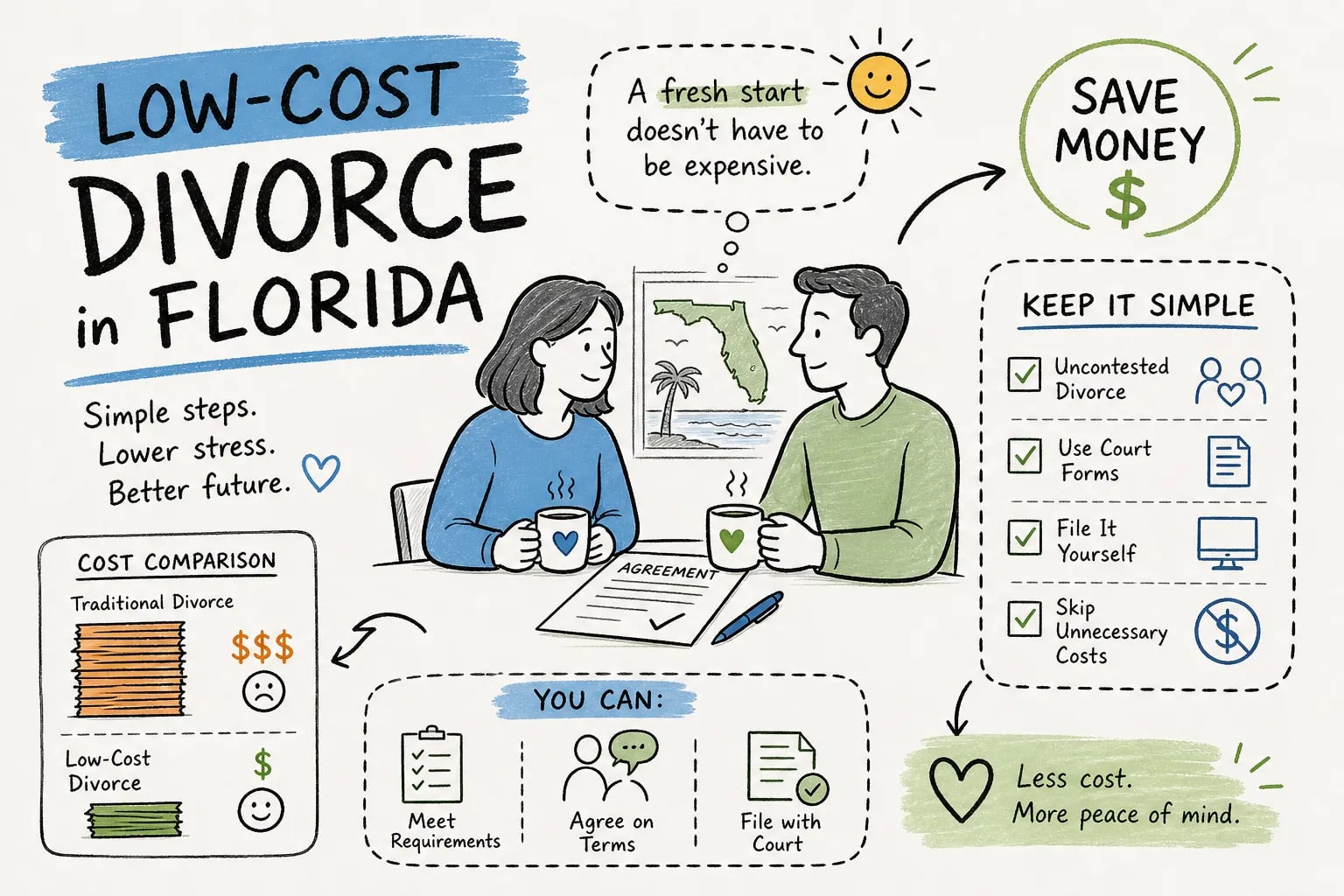
How can you get a divorce in Florida without spending a lot of money? The cheapest way is to use the simplified dissolution of marriage if you qualify, or the regular uncontested divorce process if you don’t. Both paths share the same starting point: a court filing fee of approximately $408 per the Florida circuit-court filing fee schedule, before anything else. Some uncontested cases may not require in-person court appearances depending on county procedures or the availability of remote appearances, though simplified dissolutions commonly require a final hearing and procedures vary by county. The entire process can be completed without hiring a traditional attorney.
The real cost variable isn’t the filing fee itself. It’s whether your paperwork is accurate and complete the first time you submit it. A rejected filing means refiling, delays, and sometimes the professional help you were trying to avoid from the start. Some Florida couples choose a single flat-fee service that handles documents, e-filing, and notarization under one roof rather than paying for each piece separately. We’ll show you when that trade-off makes financial sense and when a careful DIY approach works just as well.
Key takeaways
- Court filing fee baseline: Approximately $408 per the Florida circuit-court filing fee schedule statewide, though individual county clerks may list slightly different totals once administrative charges are added.
- Simplified dissolution: The fastest and leanest option, but strictly off-limits if there are minor children, pregnancy, or either spouse wants alimony.
- Regular uncontested divorce: Handles children and alimony while keeping costs low, as long as both spouses agree on every issue in writing.
- Fee waivers are real: Households at or below 200% of the federal poverty guidelines may qualify to have filing fees waived or deferred through the county clerk.
- DIY requires precision: Wrong form versions, missing notarizations, and skipped county requirements are the most common reasons cases get rejected.
What a low-cost Florida divorce actually costs
Court filing fees and what varies by county
The simplified dissolution runs about the same, though Osceola County Clerk records list it at $397.50 and other counties may land at slightly different totals once technology and administrative charges are factored in. These fees are set primarily by state statute, but each county clerk controls its specific schedule, so the total at the clerk’s window may differ from what you read anywhere online. Confirm the exact amount with the circuit-court clerk in the county where you plan to file before you submit anything.
Beyond the base petition fee, budget for a few additional line items. Summons issuance typically runs about $10 per county clerk fee schedules, sheriff service fees are often around $40 per county service fee records, and some counties charge a separate vital-statistics or final-disposition fee of approximately $10.50 when the final judgment is filed, Osceola County’s fee schedule lists this charge. None of those amounts are massive on their own, but they add up faster than most people expect when they’re focused only on the headline filing fee.
How to get your filing fee waived if money is very tight
If paying the filing fee upfront is a genuine hardship, ask the county clerk for the Application for Determination of Civil Indigent Status. Under the 2026 Florida Statutes, approval generally requires that your household income fall at or below 200% of the federal poverty guidelines for your household size.
The application asks for your household size, net income from all sources, benefits, assets, and liabilities. Bring recent pay stubs, benefit statements, and bank account statements to support what you report. If the clerk approves your application, it can eliminate prepayment of filing fees and summons fees. If you don’t fully qualify for a waiver, ask whether the clerk can authorize a payment plan or deferral before you give up on the option.
Which divorce path is right for your situation?
Simplified dissolution of marriage: the fastest, leanest option
Simplified dissolution of marriage (SDM) is available only when every item on a strict checklist is satisfied. There are no minor or dependent children of the marriage, the wife is not pregnant, neither spouse is seeking alimony, both spouses fully agree on the division of all assets and debts, and both are willing to attend the final hearing together and waive their rights to discovery and appeal. At least one spouse must have lived in Florida for the six months immediately before filing.
When you qualify, the process is straightforward. Complete Form 12.901(a) along with the required property and residency forms, arrange a corroborating-witness certificate to establish Florida residency, file everything with the circuit-court clerk, and pay the filing fee. A final hearing is scheduled no sooner than 20 days after filing. The judge confirms the facts, signs the Final Judgment, and the clerk files it. According to Nolo’s Florida divorce guide, the typical timeline runs about three to six weeks from filing to signed judgment, though timelines vary by county docket load, so check your circuit court’s current scheduling before planning around that window.
Regular uncontested divorce: when you need this route instead
If there are minor children, one spouse wants alimony, or any SDM requirement can’t be satisfied, the regular uncontested dissolution is your path. The critical word is still “uncontested”: both spouses must agree on every issue, including property, debts, alimony, parenting time, and child support, and put that agreement in a signed marital settlement agreement. One spouse files as petitioner, though some counties accept a joint filing.
The correct petition form depends on your situation: Form 12.901(b)(1) covers divorces with minor children and Form 12.901(b)(2) covers divorces without. If children are involved, a completed parenting plan and child support guidelines worksheet are also required. The other spouse must be formally served with process, or must file a waiver of service. Financial disclosures apply under Florida Family Law Rule 12.285, and the financial affidavit requirement cannot generally be waived even when the case is fully agreed. A final hearing follows to get the judge’s approval and the signed final judgment.
DIY divorce in Florida: the official forms and real risks
The official Florida divorce forms you need
All Florida family law forms are available through the Florida Courts Family Law Forms directory and your county clerk’s self-help page. You’ll also need the marital settlement agreement (Form 12.902(f)(1) without children or 12.902(f)(2) with children). Final judgment forms follow the 12.990 series depending on case type.
Cases with children require three additional forms: the UCCJEA affidavit (Form 12.902(d)), the child support guidelines worksheet (Form 12.902(e)), and a parenting plan (Form 12.995(a)). Download each form from the official Florida Courts site, complete it in full, print it, sign it, and notarize it where required before filing with the clerk. The financial affidavit must reflect monthly amounts, not annual totals. Your county may also require additional local documents, such as a civil cover sheet, vital-statistics form, or final-disposition form, so check your county’s current filing checklist before you show up at the window.
Where self-filers make costly mistakes
Using an outdated form version, skipping mandatory disclosure requirements, or entering annual figures on a financial affidavit that requires monthly amounts are among the most common reasons clerks return filings. A returned filing doesn’t just delay your case. It costs you time, potentially additional fees, and sometimes the confidence to keep going on your own. The judge can also refuse to sign the final judgment if the paperwork doesn’t hold up, which means more delays after you thought you were done.
DIY divorce in Florida is a viable path for couples who are detail-oriented and willing to verify every county-specific requirement. The risk isn’t that the forms are complicated. It’s that precision matters on every line, and there’s no one reviewing your work before it hits the clerk’s desk.
How online divorce services in Florida compare
The lower tiers are essentially document mills: they produce the forms but don’t review your specific situation, don’t handle e-filing, and don’t include notarization or mediation. The court fee is almost always extra regardless of which tier you choose. Before paying any service, confirm whether e-filing is included or just form preparation, whether notarization is covered, whether mediation is available if issues surface mid-process, and whether obtaining the final judgment is handled or left entirely to you.
How can I get a divorce in Florida without spending a lot of money? Here’s when a flat-fee service makes sense
What Divorce Harmony offers that most services don’t combine
Here’s how our service fits within that landscape. At Divorce Harmony, we combine the legal authority of a licensed Florida attorney with the neutrality of a Florida Supreme Court Certified Mediator and the support of a divorce coach, all under one flat fee. Your documents are drafted by an attorney, e-filed on your behalf, and notarized through our online notary service, no courthouse visits, no coordinating three separate vendors. We handle document preparation within 48 hours of payment and typically finalize divorces in approximately 30 days, with same-day completion available for qualifying cases.
The gap between what we offer and what a forms-only service delivers becomes most obvious in cases involving minor children. A document mill hands you Form 12.995(a) and leaves the rest to you. Divorce Harmony drafts documents for divorces involving minor children and handles e-filing and related disclosures. The same applies for missing-spouse cases or any situation where a forms kit would simply fall short. A free initial consultation confirms your eligibility and answers your questions before you spend anything.
Who gets the most value from this approach
Our service fits couples who want an uncontested divorce handled correctly without the time commitment of traditional legal representation. If you can’t take time off for courthouse visits, want a single fixed price instead of separate fees for a mediator, a notary, and a document service, or simply don’t want to risk a rejected filing, the all-in-one model delivers real value. We also draft prenuptial agreements for couples preparing for marriage, and postnuptial agreements for couples who want a clear legal framework in place without filing for divorce right now.
The bottom line: how to get a divorce in Florida without spending a lot of money
An affordable divorce in Florida is well within reach when both spouses agree and you choose the right path from the start. Simplified dissolution is the most efficient route when no children and no alimony are involved. Regular uncontested divorce handles more complex situations at the same low court-filing-fee baseline. DIY divorce in Florida works well if you’re precise and willing to verify every county-specific requirement before you file.
The trap most couples fall into is underestimating the cost of getting it wrong.
Start with our free initial consultation to find out exactly which path fits your situation before you commit to anything. Knowing where you stand upfront is the most cost-effective move you can make.
Frequently Asked Questions
Can we use the simplified dissolution of marriage if the wife is pregnant or there are minor children?
No, you cannot use the simplified dissolution if the wife is pregnant or there are minor children. Simplified dissolution is strictly off-limits in those situations and also requires that neither spouse seek alimony and that both agree on all terms.
How do we prove Florida residency for a simplified dissolution filing?
You prove Florida residency by arranging a corroborating-witness certificate and meeting the six-month residency requirement for at least one spouse. Complete Form 12.901(a) and the required residency forms, file them with the circuit-court clerk, and a final hearing will be scheduled no sooner than 20 days after filing.
What information do we need to apply for a filing-fee waiver if we cannot afford the court fees?
You need to complete the Application for Determination of Civil Indigent Status and provide household size, net income from all sources, benefits, assets, and liabilities. Bring supporting documents such as recent pay stubs, benefit statements, and bank account statements to the county clerk; approval generally requires household income at or below 200% of the federal poverty guidelines.
How long does Divorce Harmony typically take to complete a divorce and how quickly are documents prepared?
Divorce Harmony typically finalizes divorces in approximately 30 days and drafts documents within 48 hours of payment. Same-day completion is available for qualifying cases, and we e-file and notarize documents so you generally do not need courthouse visits.
Are financial disclosures required in an uncontested divorce in Florida?
Yes, financial disclosures are required and the financial affidavit under Florida Family Law Rule 12.285 generally cannot be waived even in fully agreed cases. The financial affidavit must reflect monthly amounts, not annual totals, and missing or incorrect disclosures are a common reason filings are returned.
Frequently Asked Questions About a Low-Cost Divorce in Florida
Can we use the simplified dissolution of marriage if the wife is pregnant or there are minor children?
No, you cannot use the simplified dissolution if the wife is pregnant or there are minor children. Simplified dissolution is strictly off-limits in those situations. It also requires that neither spouse seek alimony and that both agree on all terms.
How do we prove Florida residency for a simplified dissolution filing?
At least one spouse must have lived in Florida for the six months immediately before filing, and you prove it with a corroborating-witness certificate. Complete Form 12.901(a) and the required residency forms, then file them with the circuit-court clerk. A final hearing will be scheduled no sooner than 20 days after filing.
What information do we need to apply for a filing-fee waiver if we cannot afford the court fees?
Complete the Application for Determination of Civil Indigent Status, which asks for your household size, net income from all sources, benefits, assets, and liabilities. Bring supporting documents such as recent pay stubs, benefit statements, and bank account statements to the county clerk. Approval generally requires household income at or below 200% of the federal poverty guidelines.
How long does Divorce Harmony typically take to complete a divorce, and how quickly are documents prepared?
Divorce Harmony typically finalizes divorces in approximately 30 days and drafts documents within 48 hours of payment. Same-day completion is available for qualifying cases. We e-file and notarize documents, so you generally do not need to visit the courthouse.
Are financial disclosures required in an uncontested divorce in Florida?
Yes. Financial disclosures are required under Florida Family Law Rule 12.285, and the financial affidavit generally cannot be waived, even in fully agreed cases. The financial affidavit must reflect monthly amounts, not annual totals. Missing or incorrect disclosures are a common reason filings are returned.