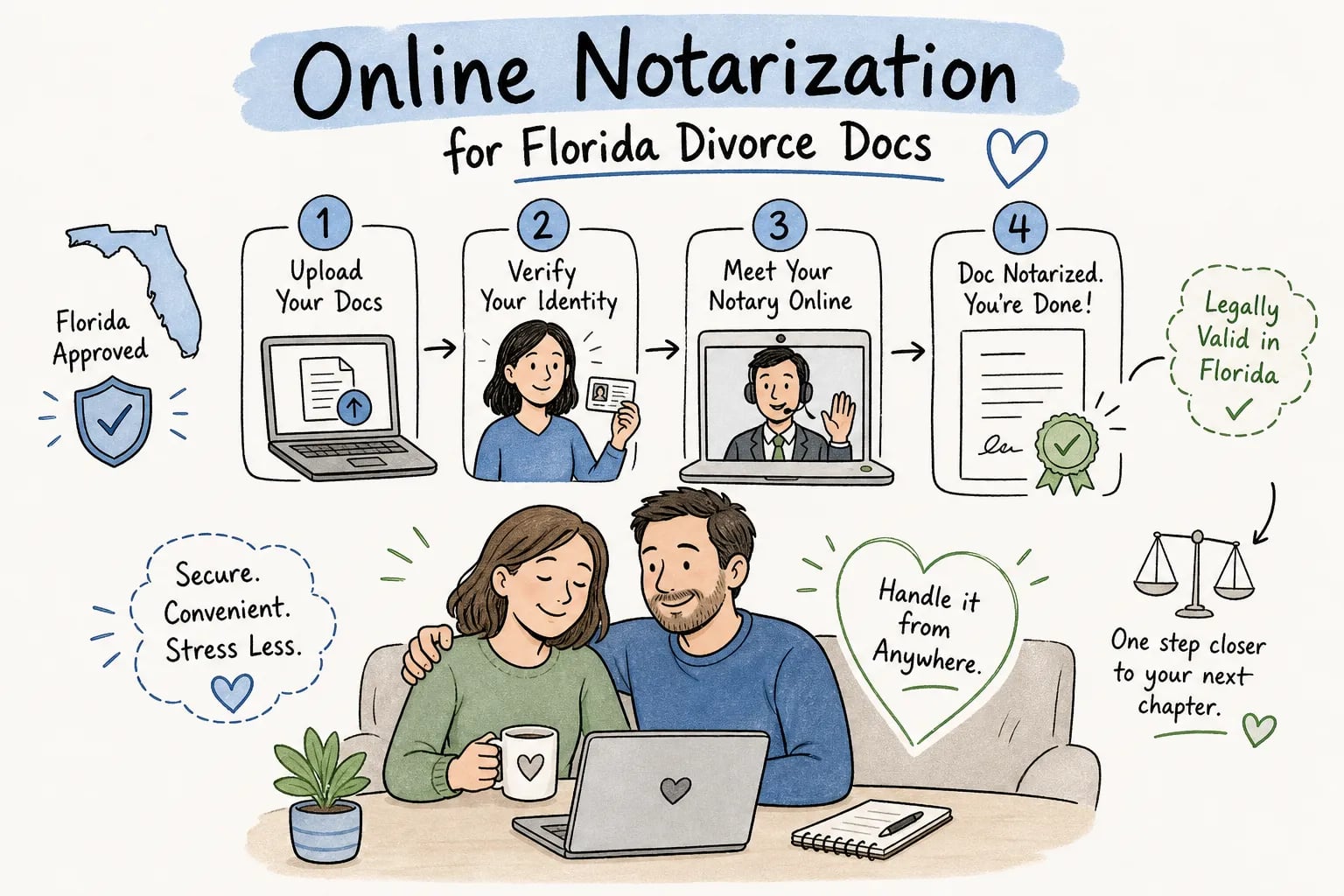
How online notarization works for Florida divorce docs
How does online notarization work for Florida divorce documents? Florida divorce documents can be notarized through remote online notarization (RON) under Chapter 117, Florida Statutes. The notary must be physically in Florida at the time of the session; the signer can be in another state or, in many cases, another country, though if you’re signing from outside the U.S., confirm with your RON provider and the filing clerk that recognition won’t be affected by local rules where you’re physically located. Florida has authorized RON since January 1, 2020, and it covers the key documents in a dissolution filing, including your marital settlement agreement (Form 12.902(f)), financial affidavits (Forms 12.902(b)/(c)), UCCJEA affidavit (Form 12.902(d)), corroborating-witness affidavit (Form 12.902(i)), and agreed parenting plan (Form 12.995).
RON validity and court acceptance are two separate things, though. A compliant notarization does not guarantee the clerk will accept your filing without corrections. This guide walks through exactly which documents qualify, what ID and technology you need, how the session unfolds step by step, and what to confirm before you file.
One practical note: if you’d rather skip the logistics entirely, Divorce Harmony handles online notarization as part of a complete, attorney-managed Florida divorce process, so you never have to coordinate it separately. Simply go to our sister site: instanotarize.com to book your online notary appointment today.
Key takeaways
- RON is legal statewide: Florida has permitted remote online notarization under Chapter 117 since January 1, 2020, with no categorical exclusion for divorce documents.
- Notary location matters: The notary must be physically in Florida; the signer can be in another state or, in many cases, another country, confirm with your RON provider and the filing clerk when signing from abroad.
- Five documents qualify: The MSA, financial affidavits, UCCJEA affidavit, corroborating-witness affidavit, and agreed parenting plan are the main candidates for RON.
- Identity proofing is required: You need a government-issued photo ID and must pass knowledge-based authentication before the session begins.
- Court acceptance varies by county: Confirm requirements with your circuit clerk before filing, and never print and re-scan an electronically notarized PDF.
- Keep the original digital file: The Florida Courts E-Filing Portal can flatten electronic notarial certificates during processing.
What Florida law actually says about RON for divorce paperwork
Florida’s RON framework lives in Chapter 117, Florida Statutes, and it does not categorically exclude family-law or divorce documents. What the law requires is that the notary hold a Florida online notary commission and be physically located in Florida at the time of the notarization. The signer’s location is irrelevant, they can be in another state or even another country, though signers abroad should confirm with their RON provider and the filing clerk that local rules won’t affect recognition of the notarization.
Chapter 117 mandates two-way audio-video communication, credential analysis, identity proofing, and a recorded session retained for at least 10 years. The Florida Department of State opened the online notary application and training process before the January 1, 2020 effective date. The notarization authenticates the signature; it does not fix a substantively defective document or substitute for correct filing procedures.
One clarification worth making: Florida’s six-month residency requirement for filing divorce is about where you’ve lived, not where you physically sign. A Florida resident who is currently traveling out of state can participate in a Florida RON session without issue. What the clerk cares about is whether the notarization was performed by a properly commissioned Florida online notary using a compliant platform.
Which divorce documents can be notarized remotely, and which cannot
Not every piece of your divorce packet requires notarization, so it helps to know exactly which forms are in scope for RON. The five documents that require notarization in a Florida dissolution and are eligible for remote notarization are listed below.
- Marital Settlement Agreement (Form 12.902(f)): Each party appears separately before the online notary during their own recorded session.
- Family Law Financial Affidavit (Form 12.902(b) or (c)): Must be sworn or affirmed before the notary; the obligation to provide mandatory financial disclosure still applies.
- UCCJEA Affidavit (Form 12.902(d)): A sworn statement fully eligible for RON when properly completed.
- Affidavit of Corroborating Witness (Form 12.902(i)): The witness must personally appear before the online notary and swear or affirm the contents.
- Agreed Parenting Plan (Form 12.995): Notarization is required when the parenting-plan form calls for it, and RON satisfies that requirement.
Documents that do not require notarization in a standard dissolution include the Child Support Guidelines Worksheet (Form 12.902(e)) and the Certificate of Compliance with Mandatory Disclosure (Form 12.932). RON is unnecessary for those unless they are incorporated into a document that does require it.
The MSA deserves special attention. Even a properly notarized MSA does not become enforceable on its own. The judge must approve and incorporate it into the final judgment, which means the document’s substance and completeness matter just as much as the notarization itself.
How does online notarization work for Florida divorce documents: ID and technology requirements
Florida RON platforms require a government-issued photo ID for credential analysis. Accepted documents generally include a state driver’s license or ID card, a U.S. passport or passport card, and certain other government-issued photo credentials. For signers outside the United States, a foreign-government passport is typically accepted under Chapter 117 even without a U.S. immigration stamp, though confirm this with your specific RON platform before the session.
Identity proofing beyond the ID check takes the form of knowledge-based authentication (KBA). The platform generates at least five questions, each with at least five answer choices, drawn from public and proprietary records tied to your identity. Under Chapter 117, Section 295 of the Florida Statutes, you must answer within two minutes and score at least 80% correct; one additional attempt is allowed with limits on repeated questions.
On the technology side, you need a working webcam and microphone, a stable internet connection, and a browser or app compatible with the RON platform. Florida law does not set a specific minimum internet speed or camera resolution, the standard is that the connection must support clear, uninterrupted two-way audio-video. Test your setup before the session so you’re not troubleshooting during the live recording. The entire session is recorded and retained for at least 10 years by the notary’s platform.
How does online notarization work for Florida divorce documents: the step-by-step RON process
Here is the exact workflow for a Florida RON session, from setup to the document you receive afterward.
- Upload or display your government-issued ID to the platform before or at the start of the session.
- The platform runs credential analysis, examining the ID’s visual, physical, or cryptographic security features and verifying details against issuing-authority data where available.
- Complete KBA: answer the identity-proofing questions within the time limit and pass the scoring threshold.
- Join the live audio-video session with the Florida-commissioned online notary, who confirms your identity on camera.
- Electronically sign the document during the recorded session while the notary witnesses it in real time.
- The notary applies the notarial certificate, electronic seal, and digital certificate, then completes the electronic journal entry documenting the credential type, credential analysis result, identity-proofing result, and the date, time, and type of notarial act.
After the session, you receive a digitally signed, electronically notarized PDF. This file is what you submit through the Florida Courts E-Filing Portal. Do not print it and re-scan it unless the clerk specifically instructs you to, because that can strip or corrupt the electronic notarial seal. Florida’s technology standards warn that electronic notarizations may be flattened during portal processing, so retain your original electronically notarized file and be prepared to provide it if the clerk or judge requests it.
Will Florida courts accept your remotely notarized divorce papers?
This is the part most people skip and later regret. A RON that complies with Chapter 117 is legally valid statewide, but each circuit clerk has its own filing procedures, and a clerical rejection can delay your case by weeks. Legal validity and smooth filing acceptance are not the same thing.
Common rejection reasons include the wrong form version, a missing or misplaced signature, an incomplete notarial certificate that lists the wrong venue or omits the notary’s commission details, a mismatch between a “sworn” document and an “acknowledged” certificate, or a PDF that is illegible or missing pages. Some clerks may flag an online notarization if the notary’s electronic seal and commission information are not clearly readable in the submitted file.
County logistics vary in meaningful ways. Hillsborough County publishes its own divorce packet with specific notarization instructions and separate virtual-hearing guidance. St. Lucie County requires particular copies and ID for in-person filings alongside notarized documents.
Broward County publishes its own family-division requirements through local administrative orders. No Florida county or circuit clerk has published an explicit written policy accepting or rejecting RON-notarized MSAs by name, which means the general “notary public” language in statewide forms leaves room for local interpretation.
Best practice: before you finalize any RON session for a divorce document, call or email the clerk’s family division in the county where your case is filed and ask whether they accept a Florida RON-notarized version of the specific form numbers you’re submitting, especially the MSA and parenting plan. Keep the original electronically notarized file and the notary’s electronic certificate as your backup.
Your clearest path forward with Florida RON
Understanding how online notarization works for Florida divorce documents is half the battle. The other half is executing it correctly for your specific county and case type. The legal framework under Chapter 117 is solid, the eligible documents are clearly defined, and the step-by-step process is straightforward once your ID and technology are in order.
What trips people up is the gap between a valid notarization and a clean court filing. Confirm acceptance requirements with your county clerk, use the correct form versions, and preserve your electronically notarized file in its original digital format. If the portal flattens the certificate during upload, you want that original on hand.
If you want the whole process handled by someone who knows both the legal and procedural sides, Divorce Harmony offers online notarization as part of a complete, attorney-managed Florida divorce service. Divorce Harmony handles document preparation, notarization, and e-filing. Reach out to schedule a free consultation and find out whether you qualify for an uncontested divorce that can be finalized without a single court appearance. Divorce Harmony’s sister site: instanotarize.com can handle all of your online notary needs. Have everything properly notarized from the comfort of your own home.
Frequently asked questions about online notarization for Florida divorce documents
Can I notarize my Florida divorce settlement online?
Yes. You can notarize a divorce settlement online in Florida under Chapter 117. The RON session must involve a Florida-commissioned online notary, two-way audio-video, credential analysis, and KBA identity proofing. Once complete, you receive an electronically notarized PDF ready for e-filing.
Does the Florida e-notary statute cover family law forms?
Chapter 117, Florida’s e-notary statute, contains no categorical exclusion for family law forms. The MSA, financial affidavits, UCCJEA affidavit, corroborating-witness affidavit, and parenting plan all qualify for RON under the statute’s general framework.
How long does a RON session take?
Most sessions run 15 to 30 minutes, depending on how many documents need to be signed and how quickly you clear the KBA step. Technical issues or identity-proofing retakes can extend that time, so build in a buffer and test your equipment beforehand.
What happens if my county clerk rejects my RON-notarized documents?
Contact the clerk’s family division directly to find out the specific reason for rejection. Common fixes include resubmitting with the correct form version, correcting the notarial certificate venue, or confirming that the electronic seal is legible in the PDF. Retaining your original electronically notarized file makes corrections faster.