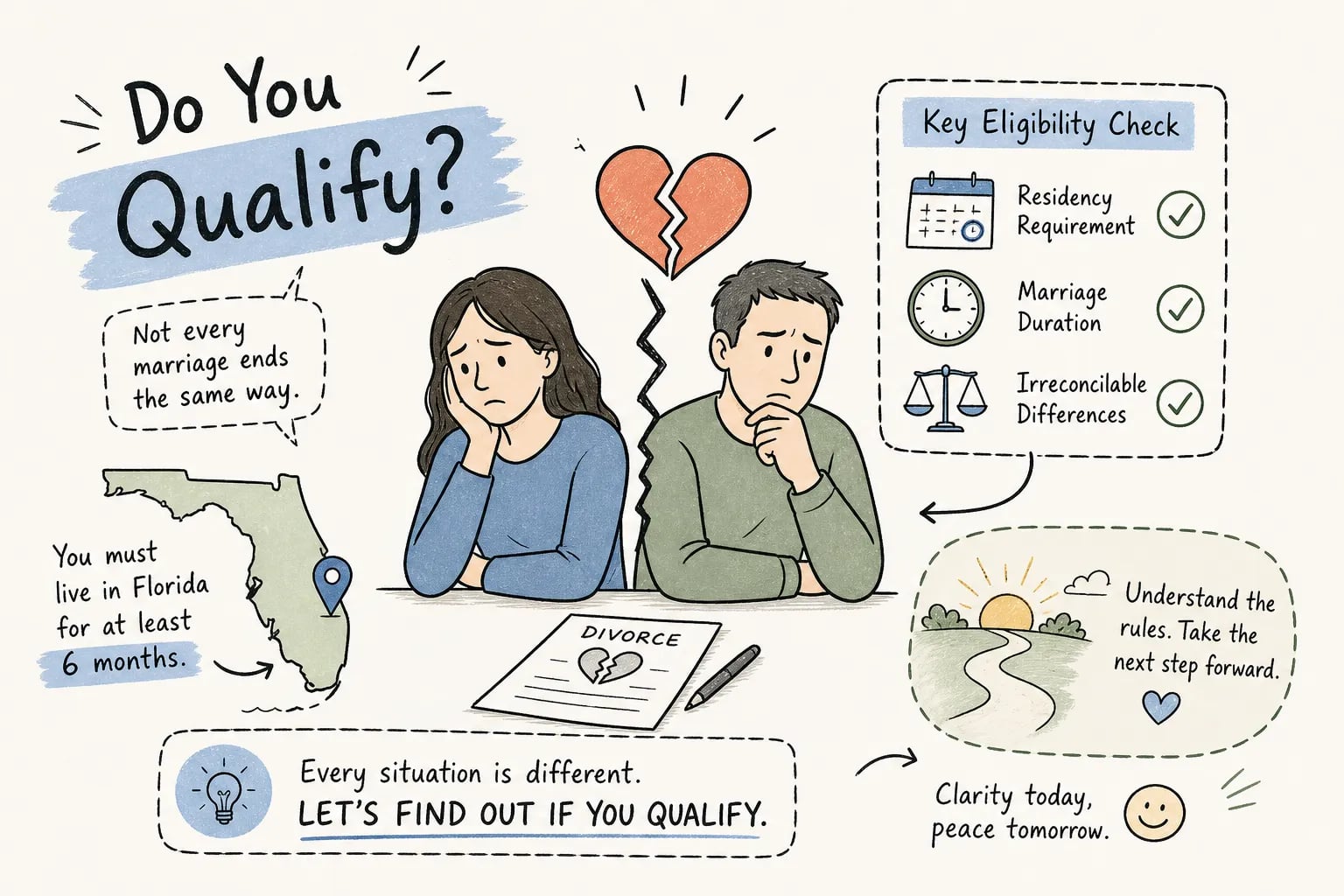
Florida Divorce Eligibility: Do You Qualify?
Most people assume they can file for divorce in Florida the moment they decide the marriage is over. That assumption can cost them time, money, and a rejected filing. Florida divorce eligibility is governed by specific legal requirements, and skipping the self-check means you could submit paperwork a court throws out before it’s even reviewed. This guide covers everything you need to know: residency rules, grounds, waiting periods, documentation, and special exceptions. It takes about five minutes to read. If you’d rather have a professional walk you through your specific situation, Divorce Harmony offers a free consultation with a licensed attorney and Florida Supreme Court Certified Mediator, Dori Shwirtz.
Florida Divorce Eligibility: What the Court Requires Before You File
Two requirements must be in place before you file a divorce petition in Florida: residency and grounds. If either one is missing, the court won’t proceed. These aren’t technicalities to work around, they’re the legal foundation for the entire case.
Florida is a no-fault divorce state. Under Florida Statutes § 61.052, the only recognized legal ground for dissolution of marriage is that the marriage is “irretrievably broken”, a standard Florida courts apply broadly. Neither spouse has to prove wrongdoing, fault, or misconduct of any kind. Courts don’t evaluate who did what to whom. If one spouse states in the petition that the marriage is irretrievably broken and cannot be repaired, that is generally sufficient.
What “no-fault” actually means for your case
Florida’s no-fault dissolution standard removes the blame game entirely. You don’t need evidence of adultery, abuse, abandonment, or any other cause. One spouse can state in the petition that the marriage is irretrievably broken, and Florida courts treat that as legally sufficient grounds. This matters because it eliminates the need for an adversarial legal strategy from the start, one reason uncontested divorces in Florida tend to move faster and cost far less than contested ones.
Key Requirements and Timelines for Florida Divorce Eligibility
Understanding the timeline is just as important as understanding the legal grounds. Two timing rules shape how quickly your case can move forward.
The 20-day waiting period after filing
Once the petition is filed, Florida law imposes a mandatory 20-day waiting period before a judge can enter a final judgment. This is a minimum, not a processing guarantee. Judicial scheduling, court backlogs, and document review all add time on top of this window. The 20-day rule is generally treated as fixed, though some courts have recognized narrow exceptions in circumstances such as domestic violence or medical emergencies, but those situations are uncommon and should be confirmed with an attorney before filing. Plan for the full waiting period regardless.
The Six-Month Residency Rule: Who It Applies to and How It Works
This is the Florida divorce residency requirement that trips people up most often. Under Florida Statutes § 61.021, at least one spouse must have been a Florida resident for six continuous months immediately before the filing date. Not both spouses, one is enough. But that one spouse must meet the standard fully, and Florida courts define residency as more than just physical presence. It means Florida is your domicile: your primary home, the state you intend to remain in. If neither spouse meets this threshold, a Florida court has no authority to grant the divorce.
Why “continuous” matters more than you think
The six months must run uninterrupted right up to the date you file. Brief travel, vacations, or temporary work absences don’t break residency if Florida is clearly your home base throughout. What does matter is whether the six-month clock has actually run. If you moved to Florida four months ago, you don’t qualify yet. There’s no partial credit and no judicial discretion for civilians who simply haven’t hit the mark.
When your spouse lives outside Florida
A spouse living out of state does not stop the Florida divorce from proceeding, as long as the filing spouse meets the residency rule. That said, dissolving the marriage and enforcing financial obligations against an out-of-state spouse are two different legal questions. Personal jurisdiction over an absent spouse, which is needed for property division, alimony, and debt orders, depends on that spouse’s connections to Florida. The court may be able to grant the divorce itself while having limited authority to issue financial orders against someone with no meaningful ties to the state.
Proving Florida Divorce Eligibility: Required Documents
Florida courts don’t accept your word alone. You need documentary evidence showing both physical presence in Florida and an intent to make it your permanent home. Strong documentation makes the process faster and smoother; missing documentation is fixable but adds steps you’d rather avoid. Gather your proof before you file, not after you’ve already submitted the petition.
The documents that carry the most weight
Primary proof of residency for divorce in Florida typically includes a Florida driver’s license or state ID issued at least six months before the filing date, and Florida voter registration. These are your strongest individual documents. Supporting records that reinforce your case include a lease or mortgage showing a Florida address, utility bills, bank statements with a Florida address, state or federal tax returns listing Florida as your residence, vehicle registration, and employment records. No single document is mandatory, but leading with your primary proof and backing it with two or three supporting records gives you a solid, court-ready file.
What to do if you don’t have standard documentation
Courts recognize that not everyone has a full paper trail. If standard documents are unavailable, Florida practice allows a corroborating witness affidavit from someone who personally knows you lived in Florida for the required period. This isn’t the preferred route, but it is a recognized one. If your documentation is thin or unclear, get it reviewed before filing. A rejected filing wastes time and typically costs more to fix than getting it right the first time would have.
Special Circumstances That Change the Eligibility Picture
Two situations come up often enough to deserve their own explanation: active-duty military members and couples where one spouse recently relocated. Both affect how the residency rule applies, but in very different ways.
Active-duty military and Florida’s residency exception
Florida law recognizes an exception for active-duty service members. If a service member is stationed in Florida, that military presence can satisfy the residency requirement for divorce purposes. Florida also treats absences caused by military orders as excused, meaning time away from the state doesn’t break residency as long as Florida remains the member’s true home state. In some cases, a Florida resident serving elsewhere may also qualify without meeting the standard six-month physical-presence requirement. The key question courts focus on is domicile: is Florida genuinely the service member’s permanent home? Military orders alone don’t automatically prove that. Anyone in this situation should confirm the specifics with an attorney before filing.
Recent relocation: what it does and doesn’t change
For civilians, there is no grace period and no exception. If you moved to Florida four months ago, you must wait until the six-month mark before you can file. Courts have no flexibility here for non-military filers, regardless of the circumstances behind the move. Meet the requirement, then file.
The Uncontested Divorce Layer: Agreements, Assets, and Children
Residency and grounds are the floor. If you want to pursue an uncontested divorce, which is faster, cheaper, and far less stressful, there’s an additional eligibility layer. Both spouses must agree on every major term: division of marital assets and debts, spousal support if applicable, and if children are involved, a parenting plan and child support arrangement. Any unresolved dispute on these points moves the case into contested territory, which changes the timeline and cost significantly.
How asset agreements affect your eligibility for an uncontested process
Florida is an equitable distribution state, which means assets don’t have to be split 50/50, but both spouses must execute a written settlement agreement that clearly addresses the division of all marital property and debt. Courts require this agreement to be filed as part of the divorce proceedings. Undisclosed assets or a spouse who refuses to negotiate knocks a case out of the uncontested track even if every other requirement is met. The agreement needs to be complete, not approximate.
Divorces involving minor children: the additional requirements
When minor children are involved, Florida requires a parenting plan that covers timesharing schedules, decision-making authority, and a child support calculation based on Florida guidelines. Both spouses must agree on these terms for the case to remain uncontested. Courts review every parenting plan to confirm it serves the child’s best interests before approving it. An incomplete or imbalanced plan will delay approval, so getting this right from the start matters.
Run This Self-Check Before You File Anything
Before you open a filing portal or call anyone, answer these five questions honestly. If any one is uncertain, that’s what professional guidance is for.
- Has at least one of you lived in Florida continuously for six months before today’s date? Not approximately. Six months, uninterrupted, as your primary home.
- Do you both agree the marriage is irretrievably broken? Florida doesn’t require both spouses to agree, but an uncontested process moves much faster when they do.
- Do you have documentation to prove Florida residency? A driver’s license, voter registration, lease, utility bills, or tax records are your strongest options.
- Have you reached, or can you reach, agreement on assets, debts, and (if applicable) children? Every major term needs to be settled for the uncontested path to work.
- Are there any military status or out-of-state complications that might apply? If yes, these need to be assessed before anything is filed.
When a five-minute consultation is worth it
If you answered “I’m not sure” to any of those questions, don’t guess. A free consultation with Divorce Harmony can clear it up before paperwork is filed. Dori Shwirtz, a licensed attorney and Florida Supreme Court Certified Mediator, can assess your situation in a single conversation and tell you exactly where you stand. No commitment, no cost. Divorce Harmony handles everything from document preparation to e-filing, reach out to find out where your case stands and what a realistic timeline looks like for your situation.
Know Before You File
Florida divorce eligibility comes down to three core requirements: one spouse must be a six-month Florida resident, the marriage must be irretrievably broken, and for an uncontested divorce, both spouses must have a written agreement on all major terms. These rules exist for good reason, and confirming you meet them before you file saves time, money, and the headache of rejected paperwork.
If you’ve run the self-check and you’re confident you qualify, you’re ready to move. If you have any uncertainty about your Florida divorce eligibility, the smartest next step is a quick conversation with someone who knows Florida divorce law inside and out. Divorce Harmony’s free consultation gives you a direct, no-pressure assessment of where you stand and what comes next. You can reach Dori Shwirtz at divorceharmony.com to schedule yours.
Do You Qualify to File for Divorce in Florida?
Answers to the most common questions about residency, grounds, waiting periods, and what else has to be true before a Florida court will accept your filing.
Frequently Asked Questions
What does a Florida court require before it will accept a divorce filing?
Two things have to be in place: residency and grounds. At least one spouse must have been a Florida resident for six continuous months before filing, and the marriage must meet Florida's legal standard for dissolution. If either piece is missing, the court won't proceed — these aren't technicalities, they're the legal foundation for the whole case.
What does "no-fault" divorce mean in Florida?
Under Florida Statutes § 61.052, the only recognized ground for dissolution is that the marriage is "irretrievably broken." Neither spouse has to prove wrongdoing, fault, or misconduct of any kind — no evidence of adultery, abuse, or abandonment is required. If one spouse states in the petition that the marriage is irretrievably broken and cannot be repaired, that's generally sufficient.
Does my spouse have to agree the marriage is over before I can file?
No. Florida doesn't require both spouses to agree that the marriage is irretrievably broken for one of them to file. That said, an uncontested process moves much faster and more smoothly when both spouses are aligned from the start, since it removes the need for an adversarial legal strategy.
How long is the waiting period after I file?
Florida law imposes a mandatory 20-day waiting period after filing before a judge can enter a final judgment. This is a minimum, not a processing guarantee — judicial scheduling, court backlogs, and document review can all add time on top of it. Narrow exceptions exist in rare circumstances such as domestic violence or medical emergencies, but those should be confirmed with an attorney before filing; plan for the full waiting period regardless.
What is Florida's six-month residency requirement?
Under Florida Statutes § 61.021, at least one spouse must have been a Florida resident for six continuous months immediately before the filing date. Only one spouse needs to meet it, not both. Florida courts define residency as more than physical presence — it means Florida is your domicile, your primary home and the state you intend to remain in. If neither spouse meets this threshold, a Florida court has no authority to grant the divorce.
Do vacations or short trips reset the six-month residency clock?
No. The six months must run uninterrupted up to the date you file, but brief travel, vacations, or temporary work absences don't break residency as long as Florida is clearly your home base throughout. What matters is whether the six-month clock has actually run in full — if you moved to Florida four months ago, you don't qualify yet, and there's no partial credit for civilians who haven't hit the mark.
Can I file for divorce in Florida if my spouse lives in another state?
Yes, as long as the filing spouse meets the residency rule. But dissolving the marriage and enforcing financial obligations against an out-of-state spouse are two different legal questions. Personal jurisdiction over an absent spouse, needed for property division, alimony, and debt orders, depends on that spouse's own connections to Florida, so the court may be able to grant the divorce while having limited authority to issue financial orders against someone with no meaningful ties to the state.
What documents prove Florida residency for a divorce filing?
A Florida driver's license or state ID issued at least six months before filing, plus Florida voter registration, are the strongest individual documents. Supporting records include a lease or mortgage showing a Florida address, utility bills, bank statements with a Florida address, tax returns listing Florida as your residence, vehicle registration, and employment records. No single document is mandatory, but leading with your primary proof and backing it with two or three supporting records gives you a solid, court-ready file.
What if I don't have standard residency documentation?
Florida practice allows a corroborating witness affidavit from someone who personally knows you lived in Florida for the required period. It isn't the preferred route, but it's a recognized one. If your documentation is thin or unclear, get it reviewed before filing — a rejected filing wastes time and typically costs more to fix than getting it right the first time would have.
How does active-duty military service affect the residency requirement?
Florida recognizes an exception for active-duty service members: if a service member is stationed in Florida, that presence can satisfy the residency requirement, and absences caused by military orders are excused as long as Florida remains the member's true home state. In some cases, a Florida resident serving elsewhere may qualify without meeting the standard six-month physical-presence rule. The key question is domicile — whether Florida is genuinely the service member's permanent home — and military orders alone don't automatically prove that, so it's worth confirming the specifics with an attorney before filing.
I recently moved to Florida — is there any exception to the six-month rule?
For civilians, no. There's no grace period and no exception. If you moved to Florida four months ago, you have to wait until the six-month mark before you can file. Courts have no flexibility here for non-military filers, regardless of the circumstances behind the move.
What additional requirements apply for an uncontested divorce?
Residency and grounds are the floor. To pursue the faster, cheaper, uncontested route, both spouses must also agree on every major term: division of marital assets and debts, spousal support if applicable, and, if children are involved, a parenting plan and child support arrangement. Any unresolved dispute on these points moves the case into contested territory, which changes the timeline and cost significantly.
How does asset division affect eligibility for the uncontested track?
Florida is an equitable distribution state, so assets don't have to be split 50/50 — but both spouses must execute a written settlement agreement that clearly addresses the division of all marital property and debt, and courts require it to be filed as part of the proceedings. Undisclosed assets or a spouse who refuses to negotiate knocks a case out of the uncontested track even if every other requirement is met; the agreement needs to be complete, not approximate.
What's required when minor children are involved?
Florida requires a parenting plan covering timesharing schedules, decision-making authority, and a child support calculation based on Florida guidelines. Both spouses must agree on these terms for the case to remain uncontested, and courts review every parenting plan to confirm it serves the child's best interests before approving it. An incomplete or imbalanced plan will delay approval, so getting it right from the start matters.